

























Looking Back To A Very Dark Time
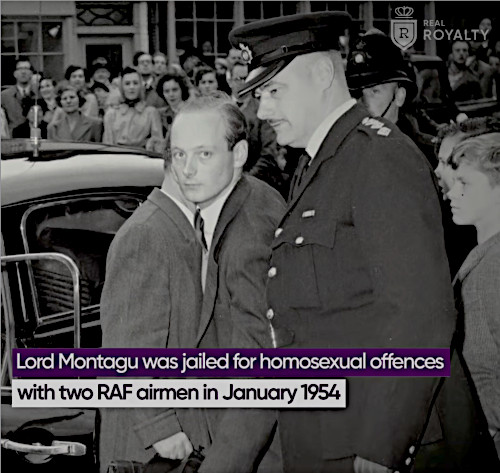
I have the book by Peter Wildeblood, who was caught up in this scandal and sent to prison for 18 months hard labor for “conspiracy to incite certain male persons to commit serious offences with male persons”…or in other words, being a homosexual and having an affair with another man. This was Britain in 1954…about a year after I was born here in the United States where things weren’t much better.
This is from the Wikipedia entry on Peter Wildeblood:
In the summer of 1952, Lord Montagu of Beaulieu had offered Wildeblood the use of a beach hut near his country estate. Wildeblood brought with him two young RAF servicemen: his lover Edward McNally, and John Reynolds. The foursome were joined by Montagu’s cousin Michael Pitt-Rivers. At the subsequent trial, the two airmen turned Queen’s Evidence, and claimed there had been dancing and “abandoned behaviour” at the gathering. Wildeblood said it had in fact been “extremely dull”. Montagu claims that it was all remarkably innocent, saying: “We had some drinks, we danced, we kissed, that’s all.” Letters from Wildeblood and Montagu to McNally, a serviceman and John Reynolds were found by the RAF. They were thus offered immunity as they agreed to turn evidence against Montagu, Pitt-Rivers and Wildeblood.
The atmosphere of the 1950s regarding homosexuality was repressive; some called this period a witch-hunt. The Montagu trial followed a number of other cases in the press, including that of Soviet spies Guy Burgess and Donald Maclean, Labour MP Bill Field, writer Rupert Croft-Cooke and actor John Gielgud. It is in this context that around 1,000 men were imprisoned each year in Britain amid widespread police repression of homosexuals.
But the case against Wildeblood attracted public attention against the law as it stood, and Wildeblood was not shy about speaking out about being homosexual, and what was done to him in the name of the law.
The verdict divided opinion and led to an inquiry resulting in the Wolfenden Report, which in 1957 recommended the decriminalisation of homosexuality in the UK.
Wildeblood’s testimony to the Wolfenden committee was influential on its recommendations. The committee was set up during the prison sentence of Peter Wildeblood in order to investigate the law regarding homosexuality and to give advice and recommendations for reform if need be. Setting up the committee was made possible thanks to increased public attention about homosexuality generated by this and other cases. Peter Wildeblood thus made a great contribution to legal reform, by providing evidence and arguments for the debate in the House of Lords where the law to decriminalise homosexuality was passed in October 1965. Peter Wildeblood was the only openly gay witness to be interviewed and his book Against the Law served as a passionate account of the case and the need for reform.
Which is a perfect example of how gay visibility helps us make progress.
I’m reading Wildeblood’s book Against The Law, but it is slow going because it takes you back to a really bad time, and I have to read it in small doses.