































Another Reason To Love Tolkien!
This came across my Facebook news stream yesterday, from user Alex Bernard in the “Dune” group…
J.R.R. Tolkien famously disliked Frank Herbert’s Dune “with some intensity”. He never wrote a detailed critique, but literary historians and scholars attribute his feelings to fundamental clashes in their worldviews, moral frameworks, and storytelling philosophies.
I’ll just leave this with two of his bullet points, because they’re really all that needs to be said:
• Moral Ambiguity vs. Objective Good: Tolkien championed stories where characters fought for objective, uncompromised good—even when faced with impossible odds, like Frodo’s quest. In contrast, Dune operates in gray areas. Its protagonist, Paul Atreides, embraces a consequentialist mindset, choosing “lesser evils” to secure power, which Tolkien would have found deeply troubling.
• Pessimism and Power: Tolkien’s concept of “consolation” involved a eucatastrophe (a miraculous, happy ending) and hope. Dune is a bleak, tragic universe where absolute power corrupts, and the ultimate outcome is inherently dystopian and complex.
That last is basically Herbert the man right there. Let me add Herbert was also a homophobe. But of course these things tend to be bundled together, springing from the core of a rotten soul. And where you really see it isn’t in the Dune novels, but in Soul Catcher; a book I have hated passionately ever since I finished it, threw it across the room and tore it to bits. When I learned later that Herbert had a gay son it occurred to me that the book was an exercise in vicariously tormenting and murdering Bruce. (Herbert detested his gay activist son Bruce, who struggled with drugs his adult life…which wouldn’t have had anything to do with how Herbert would, among other things, hook his sons up to a lie detector when they misbehaved) But it can also be seen as a purer horror story than the Dune novels. Herbert is on record as saying the character of Paul Atreides was meant to be a warning, not a hero, and you can suppose the character of Charles Hobuhet is also in that vein; a warning about men who assume they are favored by the gods. But Herbert is too cute by half here. See how many people miss what Herbert claims is is point about Paul. He knew what he was doing. He wasn’t calling out his god’s right hands; he’s admiring them from afar. And like your usual moral runt, he dresses it up in various disguises and self serving excuses, so he doesn’t have to see the creep in the bathroom mirror.
I’ve read there is some sort of effort towards turning the book into a movie, but the people working on it, with the support of Herbert’s family it seems, were trying to rewrite the end to be more “politically correct” (their own words). I can appreciate why, since the book is so thoroughly disgusting in its total indifference to child murder. But the essential problem with the book isn’t that the thirteen year old boy is murdered at the very end, only moments from when he might have been rescued. The core problem is it is yet another crazy murdering Injun Joe figure created by a white man with zero understanding and sympathy for native Americans, a moral indifference for cultural appropriation, and bitter resentment over having a gay son. Native Americans just don’t need more of that sort of thing dumped on them, and I’ll bet Bruce didn’t much like seeing himself vicariously tormented and killed by his own father. I don’t see how you make that “politically correct”. So I hear, Herbert lost his only native American friend when he showed him a draft of the story. Of course it didn’t discourage him from getting it published.
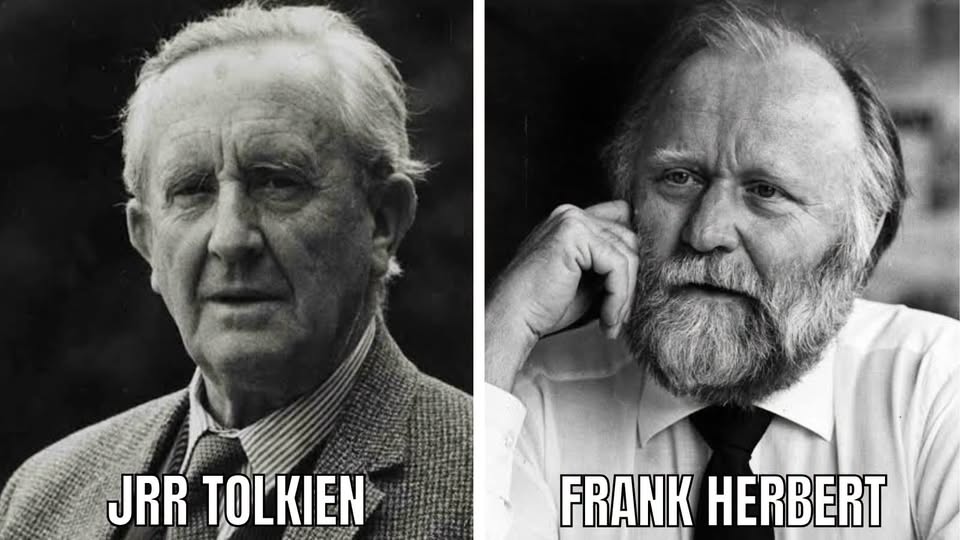
Decency versus vulgarity.
Tolkien almost certainly disliked Dune “with some intensity” because he had Herbert’s number. They could not have been more different men.