
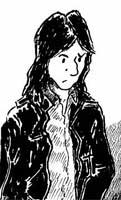





























Weird
From our Department Of Oversharing Yourself…
[Note…this has been edited massively since I first posted it. Maybe read it again?]
The other day I shared a post on Facebook about something that interests me very much, and touches on a muse that informs my artwork to a large degree. And it was just to share something that interests me but was also, in a way, like everything I put up there or on my blog, about me. The response was not exactly what I expected, but weirdlings like me get that periodically.
It was a post about the geology of the east coast and how it shaped the history of european migration into north America…
“So there is an invisible line that’s just going through the eastern US. You probably haven’t noticed it, but this line is important. You’ve crossed it again. You didn’t notice. You didn’t even know existed. But this line determines where the cities are when the rivers start getting all wonky. It’s called the fall line. Not because it’s where people fall, but it’s actually. Well, it’s where the rivers fall. Like, they. They stop being chill rivers, and they fall violently. So the fall line is the boundary where ancient hard bedrock meets softer coastal sediments. This means this is where rivers go from being chill and navigable. Navigable to white knuckle chaos. This all happens within a mile. And that’s because we have the Appalachian Mountains right there, and they’re pretty old. And over hundreds of millions of years, they eroded and dumped to this sediment along the coast, gradually dumping it eastward, creating this coastal plain. So now we have solid rock on one side and soft clay and sand on the other. And water hates this transition. That’s why every major East Coast city sits on this line. You know, you have Philly, you got Baltimore, you got Raleigh, you got Atlanta, Richmond, DC, Columbia, you name it. These are all the furthest points that settlers could reach inland before the water turned to waterfall chaos. So they stopped there, they said, that’s good, built cities, installed Mills, collected money, and the rest is literally history. Fall Line created a hydro power. Before electricity. It created trade routes. And this fall line is important today. You know, soil chemistry, flooding and seismic activity.” (post by Active Earth on Facebook)
As you can see it has a bunch of awkward language in it that I just glossed over for the fresh take on the information in it. I’ve seen badly constructed sentences like that before and it’s not always an AI artifact. People will often fiddle finger a keyboard and/or express themselves awkwardly. I can relate, I have thoroughly mucked up language in my own text from impatient editing and re-editing and then posting it somewhere I can’t fix what I later realized I mucked up. Now I try to let the words simmer a while before clicking on PUBLISH. But I understood the facts presented to be correct so I shared it. Because the artifacts geologic time and human history leave behind have fascinated and enchanted me ever since I was a small boy wandering around on foot. I just assumed everyone else I know on Facebook would be enchanted too. I make that mistake lots.
Here’s the image of the invisible line that accompanied the post…
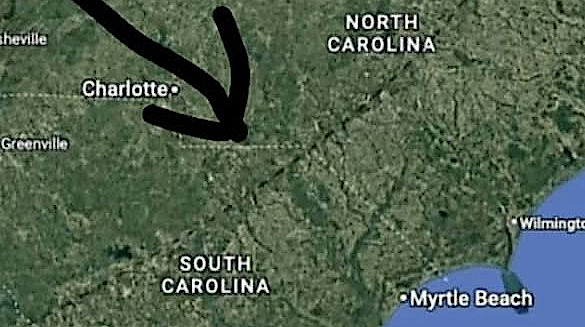
It’s not exactly invisible, in fact it’s pretty obvious once you know it’s there, but you have to have driven up and down the east coast to figure that out. I’ve been pondering it for a long time. Ever since I got my first driver’s license actually. The thing is, you don’t have to drive the roads of North America very much to appreciate how its geology has shaped human migrations and history. What gets surprising as you learn more about it is how deep into the details of our history that goes.
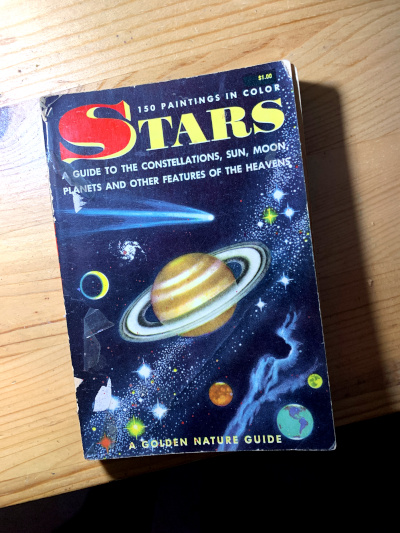
Well before I was old enough to really grasp what it was I was seeing in things like a meandering creek beds, highways, or rows of storefronts, I was thinking to myself, why is it like that? The different scales of time, human versus geological, and then to the astronomical, was a source of deeply felt awe even at that age. Mom eventually gave me a Little Golden Book Of The Stars And Planets that I still have, because she kept seeing me looking up at the night sky in wonderment.
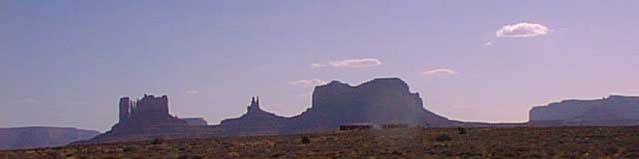
Now I take long road trips. I remember one moment I was driving through a little town called Mexican Hat in Utah and saw layers of rock in cliffsides not far from the road, bent like liquid waves in an ocean.
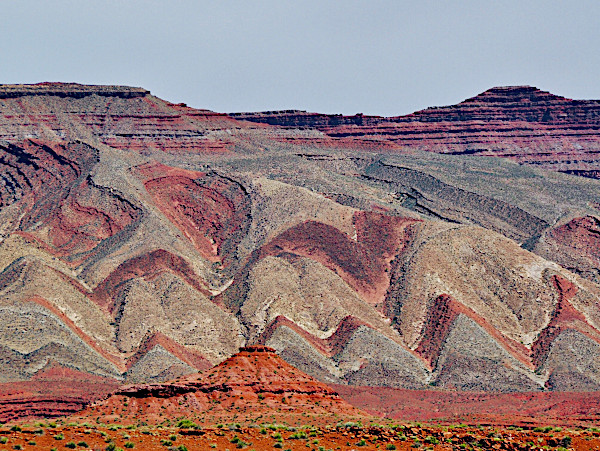
It was amazing. I had to pull off the road and get my camera out, and I just stood there for I don’t know how long drinking it all in. I tried to get a sense of how long it must have taken to bend that rock above the town into those shapes. I later learned that the rock was uplifted and tilted on its side, and then it eroded into those shapes, something like what happened in Arches National Park. I was staring at evidence of time on a scale I knew I could not grasp and it was thrilling. And then I remembered that was sedimentary rock. How long did that take to form? Right…this was all an inland sea at one time wasn’t it? And now it’s how far above sea level?
Every time I take the drive to Florida and Disney World I think about how I-95, at least from the part of it I know well from Pennsylvania to Georgia, practically defines the line between the piedmont and the coastal plains. The first major north south highway wasn’t Route 1, it was the Atlantic Highway, which brought people and settlements that they kept building because that’s what humans do. To expand, add new pavement and towns, they had to do that west of where they built that first auto trail because to the east was the sea. So that’s where I-95 eventually ended up, right along the boundary line between the old mountains and the coastal plains the erosion of those mountains helped to form, because building it there was cheaper and by then there were already local roads, like route 301 (which I still want to drive one day).
I have walked and driven it lots, that sudden transition from piedmont to coastal plains. Those shots of Great Falls in that article…
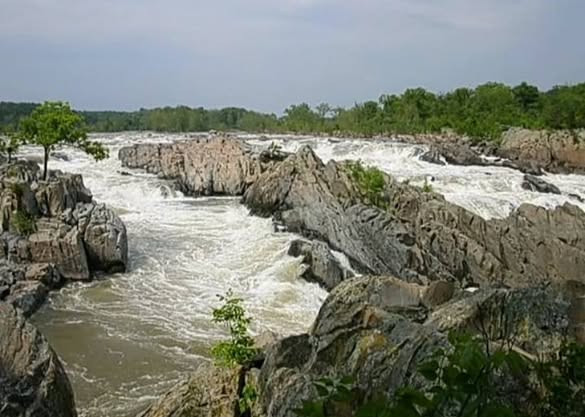
…I’ve stood there, hiked Billy Goat trail. The Potomac River is still cutting its way down to the coastal plains as you watch. Back in the day it made the river unnavigable, so they built a canal with locks on the Maryland side. An attempt to build one on the Virginia side was made and then abandoned. Then the first steam powered railroads became a thing and a railroad was built along the river that killed off the canal, which is now a park and tourist attraction. I used to hike the towpath lots.
Every time I swing around the Baltimore beltway from US 40 down to I-95 I get to see a lovely view looking down from where the Maryland piedmont drops onto the coastal plains. Early on the B&O Railroad put a tunnel under Baltimore because they figured it would be cheaper than trying to do it over the Maryland piedmont or crossing the Patapsco and it nearly bankrupted them. Baltimore straddles that divide. I live in the piedmont part of the city and can walk and few blocks and look down on the coastal plains part. I’ve seen the drop even more spectacularly whenever I went south after a visit with mom in Hillsville, down I-77, but even much more so on route 52 next to it, in the place they call Fancy Gap.
That natural barrier, one of many across North America, changed the way people migrated and you can still see it in the maps of highways, railroad and cities and towns. And here’s the thing: he past isn’t really past. It’s still there in the old main streets. In the earth beneath our feet. In the atoms and stars.
You can visualize towns forming like crystal growth around a sweet spot in the earth. Then as time goes on there is evolution. Old buildings retrofitted and made new again and again, and if you look closely you can figure out what they started out as. There’s a pest control company in a building not far from my house that was obviously once a trolly car barn. But that would have been before Hampden was part of Baltimore city and The Avenue was third avenue, not 36th street.
The story of humanity is laid out in front of you as you walk or drive, or just look at the map. It is also the story of the Earth. Which is also the story of the universe.
But this muse is something, I reckon, that sets me apart. Even among the freaks and geeks.
I get a paper cut and pause while dripping some antiseptic on it to consider how it’s red because of blood cells that hold the shards of an ancient sun. Some decades ago in a science magazine I saw a schematic of the atomic structure of a hemoglobin molecule and it indicated four iron atoms. Those iron atoms are what make it work to transport oxygen throughout the body. My weirdness tells me that, in a sense, we still burn from the heat of that ancient star. Okay, its ash. But still…
I know where you can look up and if the sky is dark enough see a fuzzy blotch of light that took two and a half million years to reach your eyes, which themselves evolved from the first mammalian eyes two-hundred million years ago, made of stardust that’s billions of years old.
That sense of the scale of time informs my art…weirdly. Where you really see it is in my pure art photography galleries. But I can see the weirdness of me in all of it, even in the photojournalism galleries. For a while I was doing oil paintings that were weird imaginary landscapes that were my musings about the infinite disregard of space and time.
I have a friend who gives me the same lecture practically every time we’re together, about how it’s okay to be crazy as long as you don’t let Them know it because you might lose your freedom. I’m not sure exactly what he’s trying to tell me but in these Donald Trump days I feel like I’m not crazy I’m just ahead of the curve (that was a Heath Ledger Joker reference). But I’m fine with me. It took me decades and finally reaching my 70s, but I’m fine with me. Mostly. I’m not hurting anyone by being me. I do my work, I pay my bills, I keep my promises and the trust of others. I look out for my neighbors. Yes I’m stubborn, I have a temper, I get impatient over trivial things. I take things to heart that maybe I shouldn’t while other things I maybe should pay attention to go right over my head. I hate being talked over, and I don’t socialize very well with more than a few people I know at a single time. Sometimes what comes out of my mouth is the tail end of a train of thought no one else in the room was privy to. Which is probably why I get Those Puzzled Looks from time to time. I make strange art.
And sometimes I toss things out there on Facebook because something about it completely enchanted me. Like that video of the blue grey gnatcatcher, or the one of that alligator attacking a painting of a deer, or the musician playing Vince Guaraldi on his electric keyboard accompanied by the clothes dryer. Cool stuff. I’d share them here but embedding videos in your blog has become a lot more problematic now that they’re business assets.
And that post about the line between the piedmont and the coastal plains.
If you don’t get what I’m sharing or why, just keep scrolling…swipe left…whatever…
[Edited Massively… Apologies if you read the previous version I put up here while I was still feeling stung over the comments I got on Facebook. I’m still feeling stung, but I think I’ve handled it better now]