I knew I was in for it when I bought a car that runs on premium instead of regular. I accepted that as part of the joy of owning a Mercedes (The Mercedes Experience…as my friend Dan puts it…). But still I had visions of all the gas station signs I saw while on the road last July, particularly in Nevada for some reason, advertising premium gasoline for over four dollars a gallon. We were having a gasoline price peak back then, right as I was taking my annual road trip vacation. I was driving the Accord, and counting my blessings that I had a car that was doing about 33 miles per gallon. I’m still in the break-in period on the Mercedes, but it looks like I’ll be getting at best around 25 mpg in it.
What I didn’t expect was how widely the price of premium varies. At least around here. The price of regular only varies by a few cents locally. Last night as I was looking to fill up, I noticed the price of premium here in the Baltimore area running between $3.10 and $2.80. I saw stations right down the street from each other, having the same exact price for regular, differing by as much as 20 cents a gallon on the price of premium. I’ve no idea why that might be.
According to global marketing information firm J.D. Power and Associates, 42 percent of all car buyers … won’t even look at a vehicle built by a U.S. company.
Dave Sargent, J.D. Power’s vice president of auto research, said [that is] a mistake.
"Many consumers still have a view of the Detroit automakers that the products are not as reliable as the imports, but what our studies show is that that is simply not true," he said.
Detroit has been closing the quality gap in recent years, Sargent said. In a study this summer of three-year-old vehicles, J.D. Power said Buick tied Lexus as the most dependable brand. In another J.D. Power study on quality, Ford won in five categories — more than any other company.
But Sargent said when it comes to cars, it takes years for perception to catch up to reality.
I appreciate the dynamic J.D. Powerman is describing. My own experience with cars designed by the Big Three is an unbroken string of hoopdies. My Honda Civic has run for more years and more miles than my Dodge Colt, Ford Escort, Chevy Cavalier and Chevette combined. Those earlier cars all broke down so often, stranding me at so many key moments, that I can still feel the anxiety of those strandings in my muscle memory. Just thinking about it makes my stomach churn. I can’t imagine easily coming around to feeling secure about relying on another Ford or Chevy to get me from point A to point B if I need to get there.
I have no problem with buying an American-made car — my Civic was built by the UAW in Ohio, my Escort was built in Korea — but it will be a long while before I overcome my hard-earned, visceral distrust of Detroit engineering.
That’s me. My first car was a 1973 Ford Pinto and I loved it, and got 135k miles out of it (by taking care of the motor fanatically…changing the oil every two-thousand miles and so forth…) and still it broke down on me repeatedly. But it was 1973 and that was just what you expected of cars back then. Except for the Mercedes, which back then was legendary for its bombproof reliability. My mom’s first car was a 1968 Plymouth Valiant slant six (we were carless for most of my childhood), which just ran and ran and ran. But after she traded that one in, she endured a string of just awful Chryslers and I swear I wouldn’t trust a Chrysler motor any further then I could throw it.
I endured a string of really marginal used cars myself after the Pinto…but that was mostly because I was flat broke more often then not, and couldn’t afford more then a couple hundred buck junker. Then I started getting work as a software developer, and could actually afford a new car, and bought a 1993 Geo Prism on the recommendation of Consumer Reports. I got over 200k miles out of that car, and it never once left me stranded. Under the skin, that car was a Toyota Corolla.
My next car was the Honda Accord I just traded in. I drove that thing across the Imperial Valley and the wastelands of Western Wyoming and Idaho and eastern Oregon and never once worried that it would break down on me in the middle of nowhere. Thing is, that Accord, and that Geo Prism, were both made in America, by American labor.
American labor can build solid, reliable cars. But for ages it seems to me, Detroit just doesn’t want to design cars that way.
So I understand that aspect of what the J.D. Power guy is talking about. But he fails to notice another equally significant reason that the Big Three automakers have a lousy reputation: They’ve spent millions of dollars over the past several decades on a PR campaign designed to persuade us that they don’t know what they’re doing.
General Motors, Ford and Chrysler have loudly insisted for years that they are technologically incompetent. They have spent millions of lobbying dollars to explain all the things they cannot do, all the improvements they are unable to make, all the ways their abilities, designs and engineering are inferior to those of their competitors. All of that money spent advertising their limits and incompetency has had an impact. American car buyers listened. We believed them.
Consider, for example, CAFE standards — targets for corporate average fuel economy. Every time that Congress or Al Gore or the Sierra Club has suggested these standards should be higher, Detroit shrieks that they can’t take the pressure, that it couldn’t possibly be done, that they don’t have the skill, the know-how or the basic competence to pull it off. Toyota, Honda, Mercedes and Volkswagen, on the other hand, just said, "More fuel-efficient vehicles? Hai. Ja. We can do that. We’re good at making cars."
The same thing happened earlier with air bags and emissions standards. When California passed strict new emission standards in the 1990s, GM and Ford shipped their top lobbyists to Washington and Sacramento to argue that the new rules were technologically impossible. Toyota and Honda didn’t send lobbyists — they sent cars that met the new standard. The same dynamic occurred even earlier with seat belts. With GM’s lobbyists arguing that the company wasn’t capable of meeting the technological challenge of the seat belt why should consumers trust them to build reliable engines?
You know…I hadn’t thought of this before, but it fits. I can appreciate the big three arguing against government dictating auto design…I don’t agree with it on the basis of safety and emissions standards…but I can see them making that argument. But that’s not the argument that emphasized. Instead, like Fred says there, they cried doom and gloom and said repeatedly, over every friggin’ safety or emissions requirement, that it couldn’t be done. Meanwhile, Europe and Japan just kept..well…doing it.
It’s not that Americans can’t build good cars. It’s not that Americans can’t engineer good cars. It’s that corporate management didn’t want to. The mindset was, good enough to roll out of the factory is good enough. If there are problems, fix them after the fact, until the warranty runs out.
It’s not that they just didn’t design them to be maintained or repaired either…I remember one car, I think it was the AMC Pacer, which needed to have the engine jacked up to replace one of the spark plugs…a routine operation, something you did with every tune-up back in those days…but they didn’t design them to be Assembled either. I remember looking under the hood of the Toyota a friend bought in the late 1970s, when Japan was starting to actually worry Detroit. It was a marvel. Not only where there all sorts of little things they did in there to protect vulnerable hoses and electrical cables from the engine compartment environment, and thus decrease the likelihood of a breakdown, but there was all kinds of little things they did, that you could see, to the individual components to help the assembly line workers put it together right the first time. Little tick marks, or fittings on the individual parts that at a glance told you, attach this part to this other part Here…This way. You didn’t have to even think about it. The pieces Told You how to put them together. That kind of thinking did not penetrate Detroit management for decades. I’m not sure it has even now.
You go to a Toyota or Honda showroom now, and you’ll see some of the finest cars American labor can build. Absolutely world class stuff. They’re just not Detroit designs. And that’s not the fault of American engineering either. I recall reading a few years ago, about a guy who’d been put in charge of GM’s Cadillac devision, who was proposing to build an American supercar, something to compete, not merely with the top of the line Lexus, Mercedes and BMWs, but with Rolls and Bentley. Right On, I thought. It doesn’t matter if the market for something like that is small…Build It dammit! Let’s produce one America sedan that’s made as well as a car can be made, not just at the state of the art, but defining it, and cost be dammed. Go ahead and make it for the fabulously rich…and maybe…hopefully…the techniques learned will trickle down to the rest of the GM line. You think what Toyota learns while making Lexus doesn’t find its way eventually to the Camry? That’s why they’re so damn good…they have a line where they just go for it. Every car maker should have one of those.
But no…it was never done. And I don’t think that guy’s with Cadillac anymore. The new styling in the line since the 1990s is his, and maybe some engineering improvements. But Cadillac still has the worst reliability record of any luxury model. That’s not the fault of the people who build them. American workers can build a great car, if they’re given a great car to build.
My love of driving, of the simple, singular act of driving a car down the road, never mind where I’m going, or if I’m going anywhere in particular, believe it or not actually makes me an oddity in this country. That’s right. In a country where they say the automobile is god, a nation of car worshipers, when I tell people I regularly take cross-country drives to visit family out in California, that I’d Much rather drive it then fly because for me the road is the vacation, people look at me like I’m crazy. You drove all the way to California…???
Oh yes…we love our cars. More precisely I think, we love the independence they give us. We don’t have to construct our lives around bus or a train schedules. We can go where we want, when we want, live where we want, shop where we want, play where we want. The car made the suburbs possible. The car is an integral part of our economy. And we make our own cars into statements about ourselves. They are our status symbols, our tricked out souped up air conditioned chrome and burled walnut accented inner child. We love our cars. It’s driving we hate. Mostly.
And to tell the truth I hate it myself when it’s heavy commuter or weekend shopper congestion I have to wade through. I hate traffic so much I bought a home within walking distance of work, and two good supermarkets. I could have bought a nicer one elsewhere in the city, but then I’d have to drive to work and I hate commuter traffic. With a passion. I don’t very much care for weekend shopper traffic either.
I’m just pondering all this because of a discussion I came across on another blog I visit often. Brad DeLong writes, "Time to Whomp the Drivers!", riffing on Megan McArdle. riffing on James Joyner…
Megan McArdle: I think James Joyner is absolutely right here:
I’m now commuting into D.C. on a near-weekdaily basis. According to GoogleMaps, the office is 13.5 miles from the house. I can usually drive there in 45-60 minutes during off-peak hours, although it can sometimes take much longer if there’s an accident. I can park in the garage next to my office for the day for $12. Conversely, I can drive 15-20 minutes to a Metro station, pay $4 to park, wait as long as 15 minutes for a train, pay another $2.65 to get two blocks from the office 35-50 minutes later, followed by a 5-10 minute walk to the office.
So, in order to save $2.70 (plus a nominal amount of gasoline), it would cost me 30-75 minutes each day for the round trip, plus the privacy and autonomy I enjoy in my own vehicle. Given that I earn enough that $3 is poor compensation indeed for that much of my time, I drive unless there’s a really good reason not to.
And they’re about to raise the rates for Metro fares and parking, further skewing the calculus in the direction of “drive.”
The massive subsidy provided to drivers in the form of free roads is obviously producing highly inefficient outcomes, which is why DC feels like a prison from which it is impossible to escape unless one wants to spend four hours on the Beltway. We clearly need to institute comprehensive road tolls combined with a congestion pricing scheme. Plus, of course, a carbon tax to compensate for the negative externalities drivers are imposing on those of us who use primarily mass transit.
I have a suggestion. Why not make cities more livable? In fact…I made this suggestion in the comments, where I said in part…
Driving long distances, for many hours out of your life a year, in stress inducing commuter traffic, already makes driving unattractive. Weekend shopper traffic is equally ugly and stressful. But as long as where people work, where they shop, and where they live are kept in separate corners people will just keep driving, and keep absorbing the cost of it.
My comment was promptly ignored, and a discussion of driving costs verses public transportation costs ensued. It’s not just that I’m a boring conversationalist…I’ve seen this happen before whenever this topic comes up. The obvious solution to traffic congestion, and the national gasoline bill, is to put jobs and basic needs shopping and housing within walking distance of each other. For bonus points, add an enjoyable night life to the walkable mix. Not everyone will want to live in the city, not everyone will want to be that close to work. But as traffic keeps getting worse and worse, and the cost of oil keeps going up and up, people will begin migrating back to the cities, if the cities are made livable. And that’s fewer cars on the roads, and less oil consumed. But they’ll only do that if the cities are made more livable. And this country doesn’t seem to want to have a conversation about doing that.
Even in cities with a thriving economy it’s a problem. My understanding is that D.C. doesn’t want to put housing, never mind affordable housing, near the major office zones. One neighborhood in D.C. that approaches livability very nicely is (surprise, surprise) the little gay neighborhood near DuPont Circle. It’s got housing (if you have to ask you can’t afford it housing, but still housing), shopping, and an active nightlife. It’s streets are walkable and it’s atmosphere is casual and welcoming. Metro is nearby. It’s a nice enclave close enough to some of the major office spaces that you could conceivably work and live there. I’m sure there are other enclaves like it elsewhere in the city, but not enough of them. The big downtown office zone is dead at night, except for a few bars scattered around the fringes. Anytime you see dead zones in a city, that almost certainly happened because some jackass city planners decided to make the area homogenized in some unnatural way.
In an area with as much traffic congestion as D.C. has, there’s probably tons of people who would be interested in living in the city, and within walking distance or a short Metro ride from where they work. But for one reason or another they feel they can’t. The availability and cost of housing. Fear of crime. Nowhere to go and nothing to do evenings and weekends. Streets that aren’t walkable. Schools that are run down. City services that are inadequate. Few safe places for kids to play. They don’t see city life as being viable. That’s the problem.
Suburbanites for some reason though, want to complain about traffic, and greenhouse gases, and carbon usage, and gasoline taxes, and highway construction (pro and con) but they don’t want to talk about making cities livable. Go figure.
A Northerner walks into a bar in the Deep South around Christmas time. A small nativity scene is behind the bar, and the guy says, "That’s a nice nativity scene. But how come the three wise men are all wearing firemen’s hats?" And the bartender says, "Well, it says right there in the Bible–the three wise men came from afar."
More Someone, Some Guys, Some Things walk into a bar jokes Here.
I’m reading a post on After Elton about gay comic book heros, or more precisely the darth thereof, and how the ones that are out there seldom fare much better then other gay characters in pop culture fiction…
Comic writer Mark Millar isn’t thrilled to learn that his story was the breaking point that inspired Perry Moore to tell a positive story of a gay superhero. A 2005 story by Millar was brought up in Sunday’s New York Times profile of Moore:
But things work out relatively well for him, which makes sense given Mr. Moore’s distaste for how some gay comic-book characters have been treated. His hackles still rise at the death of Northstar, a mutant hero who made headlines in 1992 when he uttered the words “I am gay” in the pages of a Marvel comic.
…
Death is rarely final in comics, so it’s no surprise that Northstar came back to life. “They couldn’t bother to mention he was gay,” Mr. Moore said of Northstar’s most recent appearance in “X-Men.”
Taking a cue from Gail Simone, a comic-book writer who first gained notice as a fan with her Web site, “Women in Refrigerators”, detailing the mistreatment of female heroes, Mr. Moore created his own tally. “Who Cares About the Death of a Gay Superhero?,” which he has delivered as a speech, includes more than 60 gay and lesbian comic book characters who have been ignored, maimed or murdered.
“Yes, bad things do happen to all people,” he wrote in it. “But are there positive representations of gay characters to counterbalance these negative ones?”
Not nearly enough, Mr. Moore said, and that’s one reason he wrote “Hero,” for which he already has ideas for future installments.
Millar wasn’t thrilled to see a story he wrote mentioned as a low point in superhero comics’ treatment of gay characters, and he reacted on his website:
Oh, tell him to f**k off.
He didn’t die because he was gay. He died because he’d been brainwashed by The Hand.
Well that explains it. If that’s not geek enough for you, there’s always the reader comments, where one poster named ‘Cylon’ defends the treatment of Northstar thusly:
I think it was just a bad coincidence that he died three times that month…
He also died in X-Men: The End and Age of Apocalypse. I hope he’s getting workman’s comp out of all this.
I’ve been reading a lot of Yaoi manga lately…stuff I’ve been buying almost by the ton from Amazon. It’s probably a symptom of how starved for romance I’ve been most of my life, because in case you aren’t aware, yaoi are Japanese boy meets boy soap opera kinda stories, mostly marketed I’m told, to teenage Japanese girls. When I joked in my cartoon series A Coming Out Story, about how I’d once had a stash of Tiger Beat and 16 Magazines under my bed, I wasn’t kidding. And my tastes in comic book superheros ran more toward Spider Man then The Incredible Hulk. I think Denny O’Neil and Michael Kaluta created a far more formidable dark knight in The Shadow (I have Every issue), then Frank Miller’s aging bar stool reactionary Batman. I’m not generally attracted to the over muscled double-y chromosomed hulking bodybuilder genre of comic book hero, or to stories that are little more then blood and guts, slash and burn. But the word ‘yaoi’ was originally coined as a term of derision by teenage Japanese boys, and it’s basically so I’m told, an acronym that means "no climax, no point, no meaning".
I want my torrid same sex romance. But I’d also like a little action and adventure please. It would be Real Nice if some publisher could combine all these elements someday. Or maybe it already is out there somewhere and I just haven’t found it yet. Every now and then the manga creators manage to sneak in some Super Hero-ish elements. One title I’m reading now, Hero Heel, the story of an actor cast as a TV superhero, who finds himself falling in love with the actor who plays the series super-villain. I’m hopeful about the possibilities here. Already in book one the creator Makoto Tateno seems to be weaving the plotline of the actor’s realtionship, with the plotline of the space opera they’re acting in. This could be fun…
No…the guys of manga aren’t generally over muscled double-y chromosomed hulking bodybuilders. They’re just unabashedly beautiful. And the stories are unapologetically about love and desire. Which is why I keep buying the damn things. But high art they’re not. Hmm…Northstar is actually pretty good looking…at least in this artist’s take…
…too bad he keeps dying. Seriously…read Perry Moore’s Who Cares About the Death of a Gay Superhero, and you’ll see why I’m skeptical that the big comic book publishers, with their business focus on the fantasies of straight teenage boys and twenty-somethings, who also happen to be the demographic group responsible for most gay bashings, will ever be able to treat gay characters with much respect. Of course Northstar had to die. Read Moore and you’ll see how gruesomely, and what his fate was after being "resurrected". The surprising thing is they only killed him three times.
Trinity Preparatory School canceled its opening-night performance of La Cage aux Folles on Friday at the request of Bishop John Howe, head of the Diocese of Central Florida.
"His request was not to stage the production, and we decided to honor his request," said Headmaster Craig Maughan, who called off Friday’s and tonight’s planned performances. "I met with the cast and all the people involved in the production and announced the decision and explained it to them."
…
Howe, a leader of conservative bishops in the Episcopal Church, USA, has been vocal on issues of sexual orientation and in 2003 strongly opposed the election of an openly gay man as bishop of New Hampshire. That election, and the issue of blessing same-sex unions, has created a rift in the Episcopal Church.
I can appreciate Howe’s position regarding La Cage. The play has two central and very flamboyant gay characters in it. But the play is not about homosexuality. It’s about what happens when people are forced into pretending they’re something they’re not, to appease the cheapshit prejudices of others. It’s about the hypocrisy of the self righteous bigot. And even more unforgivably…it’s a comedy. It laughs at hypocrites. And as every pinched faced autocrat knows, it’s dangerous to allow students to laugh at hypocrisy.
I don’t know where, exactly, my copies of The New Yorker are printed, but I imagine it’s pretty far away. Yet somehow, each week, the magazine travels from the printer, to the warehouse, to the post office it is shipped from, then to my post office and, finally, to my personal mailbox. And then always, each week, as I take the new issue out of my mailbox, two subscription blow-in cards fall out onto the floor of the lobby.
I cannot figure out whether: A) the cards somehow know they’ve arrived at their final destination and refuse to fall out before then, or B) The New Yorker initially stuffs my magazine with dozens of these blow-in subscription cards and the others have all fallen out en route.
They aren’t stapled into the magazines of course, because the marketing departments figured out that when they fall out it makes you pay attention to them. Which really annoys me when they’re falling out of magazines I’m already subscribing to. And doubly so when it’s my monthly copy of Consumer Reports.
Warning…Fred’s blog post there also contains major earwormage. As you value your mental peace and quiet, Don’t Start That YouTube Video! Ask me how I know…
BROOMFIELD – It started with a simple question and ended with at least one student chanting "white power" in a classroom.
It happened Tuesday in a classroom at Holy Family High School, the Catholic school that sits at the corner of 144th Avenue and Sheridan Boulevard in Broomfield.
The classroom discussion started with the question: Why do students need to learn Spanish?
According to the Archdiocese of Denver, the conversation soon became about immigration and it turned ugly.
"It became a heated discussion and some rhetoric was used that was inappropriate for the classroom," said Jeanette DeMelo, spokesperson for the Archdiocese of Denver.
At least one e-mail sent to 9NEWS said that at least one student started a chant of "white power" and some said that all Mexicans should go back to Mexico.
There were Hispanic students in the classroom at the time. They asked to leave the classroom when the bigot explosion erupted. The school says they were allowed to leave. The students say they were forced to stay in the classroom and endure being trashed by the other kids.
The Archdiocese says they did not expect something like this to happen in their system, which has embraced its Hispanic students. Archbishop Charles Chaput has come forward several times in support of the Mexican community.
Right. Like you’ve embraced your gay students too I’ll bet. You teach contempt for one group of people, and next thing you know contempt just takes wing and flies wherever it damn well pleases, doesn’t it? Who’s your Jesus Charles…the one that loves all the children, or the one that loves some of them more then others?
Disgraced pastor Ted Haggard won’t be fundraising for a Monument nonprofit run by a sex offender, won’t be ministering to anyone and needs to get a job, his overseers said in a statement released this afternoon.
"Mr. Haggard’s solicitation for personal support was inappropriate," his church supervisors said in the statement.
The statement came one day after the four-member team of ministers responsible for overseeing the spiritual restoration of Haggard met with him in Phoenix.
Last week, Haggard had e-mailed a KRDO-TV reporter in Colorado Springs, asking that supporters send contributions to Families with a Mission, a Monument non-profit run by Paul Huberty…
Who upon further investigation, turned out to be…
…a twice convicted sex offender.
In his fundraising solicitation, Haggard said he was looking for people who would be willing to support him and his wife, Gayle, monthly for two years while they sought to obtain their counseling degrees from University of Phoenix.
Haggard had also told KRDO that he and his family were planning to move into the Phoenix Dream Center, a halfway house, where he and his wife, Gayle, would minister to the "broken people" there.
The overseers said Wednesday that Haggard will not be moving into the Dream Center.
"It was never the intention of the Dream Center that Mr. Haggard would provide any counsel or other ministry," wrote the overseers.
"Mr. Haggard will not be moving in or working with the Dream Center. He will not be doing any ministry. He will be seeking secular employment to support himself."
Take a bow, Dave Coffman. It was Coffman who discovered that Haggard had had directed his supporters to send him money via a convicted sex offender, and it was this revelation—which we broke here on Slog—that brought the wrath of Haggard’s overseers down on his head. Good work, Dave!
Oh, man. What a great day. I fucking live for the day when every asshole out there bilking gullible Christians out of their hard-earned dough—from the Nazi pope on down—is told the same damn thing: Get a fucking job, you parasite.
I’d just like to add that goes double for the folks who run PFOX, Exodus, Evergreen, and other assorted ex-gay ministries everywhere…and…especially you John Smid. Get A Fucking Job, You Goddamned Parasite!
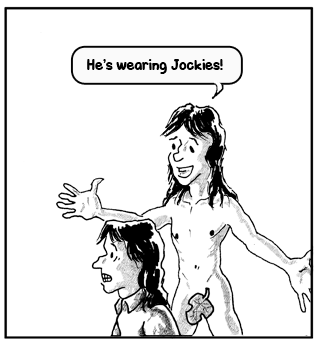
Actually, the real object of my affections back then wore BVDs. Most days I could tell anyway. But I thought Jockeys were sexier back then (though I wouldn’t admit it) and so I used a little artistic license there.
Back when I was still trying to convince myself that I wasn’t gay, oddly enough I could tell exactly what kind of underwear a guy was wearing just by getting the slightest glimpse of the waistband…usually in gym class. If I could see enough of the stitching through a guy’s gym shorts, or if he was wearing his pants tight enough, I could tell that way too.
"T.K." used to drive me absolutely nuts whenever he was out on that tennis court. Not only did he wear his gym shorts very tight…tight enough that I could clearly see the lines of his underwear…he’d wear a loose t-shirt that didn’t quite go all the way down his waist. So every time he took a swing at the ball I’d get a glimpse of his stomach…and that little bit of elastic waistband. At 17, it was electrifying. For the life of me I couldn’t turn my eyes away. But I knew I wasn’t sexually attracted to guys.
If you’d asked me anything back then about women’s lingerie I wouldn’t have had clue one. Matter of fact, I still don’t. For a bit of fun…hang out at the Victoria’s Secret at your local shopping mall and watch guys as they walk by. Most of them just can’t not look…even if their wives or girl friends are with them. And some are completely oblivious. That would be me, usually. Too bad there isn’t a men’s equivalent store chain. I’d make it a point to stroll past its window every time I walked in a mall with one.
At the end of episode ten, my libido warns my teenage self that things get more complicated after they invent designer underwear. But it’s a happy complexity…
Many religious homes are very judgmental about homosexuality. Ex-gays go through exaggerated attempts to repress, control and avoid their sexuality—in a way that parallels the dynamics of sexual anorexia. Ex-gays have come to see me talk about believing their homosexual urges were sick and wrong. They believe their homosexuality is a sexual addiction and try to use Patrick Carnes’s model to set boundaries around their “sexual acting out” behavior. They speak of hating themselves for having these homoerotic urges and would never consider acting them out. Instead, they work hard at repressing them. Preoccupied with any feelings toward the same gender, they’re extremely judgmental toward those who do live out their homosexual orientation, sexually and romantically. They tell me they don’t believe me when as I say I’m happy in my life as a gay man.
Ex-gays go to extremes to avoid sexual contact with the same gender, even if it means behaving in hateful ways—such as trying to pass legislation against gays. I strongly believe that those in the forefront of the ex-gay movement suffer from sexual anorexia and self-hatred about homosexuality, which was taught to them as children. So many come from families, cultures, and communities that disdain homosexuality, and have incorporated this to such an extreme that they can never fully actualize themselves as the gays and lesbians they were meant to be and truly are. Along with their true sexual orientation, they have shut down their capacity to be loving and accepting, particular toward other gays and lesbians.
Joe’s site deals with a topic I’ve often thought about…why essentially heterosexual guys have sex with other guys. Joe takes pains at the top of his blog to assure us he’s not doing "reparative therapy"…
This site is about men who have sex with men (MSM) who question their sexual orientation. This is not intended for reparative therapy, religion or pornography. This site is about the many reasons men engage in sexual contact with other men that are not about homosexuality. It will educate readers on the differences between sexual identity, sexual behavior and sexual fantasy.
I say this topic is of interest to me, as a gay man, because I’ve often found myself, irritatingly, on the receiving end of a straight guy’s attentions. In my college years, it occasionally came from other straight friends. Often after they’d just broken up or had a fight with their girlfriends. I always tried to handle those as tactfully as I could, and I’m still friends with some of them all these years later, but it’s demeaning. And especially so when I have to live in a society that treats gay people as second class citizens. Sure buddy…you can have a little fling with me…the day I can wear a wedding ring like yours…
You hear a lot of joking among gay folks about picking up not-so-straight straight guys. In Memphis a couple years ago I was told by a guy working at a gay bookstore, that the community there in Memphis was mostly married men, who had sex with guys on the side. And I was hearing from some friends who’d been on an ocean cruse that the sexual pickings on a gay cruse are vastly more limited compared to that on a regular, mostly heterosexual one. It’s, I’m happy to hear, easier to find a willing straight guy on a mostly straight cruse then a guy on a gay cruse who would cheat on his boyfriend. I’m sure a lot of deeply closeted gay men do that sort of thing. But the fact is that there are essentially heterosexual men who do it too and I’ve never thought that was healthy. I’m finding that Joe’s blog is shining a helpful light into that kind of behavior on the part of straight men. It’s certainly reinforcing my belief that it isn’t healthy.
This, for some reason, has been playing on my iPod almost constantly since I left Memphis…
I can feel it coming in the air tonight, oh lord
Ive been waiting for this moment, all my life, oh lord
Can you feel it coming in the air tonight, oh lord, oh lord
Well, if you told me you were drowning
I would not lend a hand
Ive seen your face before my friend
But I don’t know if you know who I am
Well, I was there and I saw what you did
I saw it with my own two eyes
So you can wipe off the grin, I know where you’ve been
Its all been a pack of lies
And I can feel it coming in the air tonight, oh lord
Ive been waiting for this moment for all my life, oh lord
I can feel it in the air tonight, oh lord, oh lord
And I’ve been waiting for this moment all my life, oh lord, oh lord
Probably because I saw something while I was there that rekindled a long smoldering anger.
When I saw this photo on Made In Brazil, taken on a Paris fashion runway, at first I was disgusted. Then I thought about it some more and realized that nothing would piss off those fundamentalist nutcases like being made into a sex object. Take that al Qaeda…
Actually…I could see that as a fashion statement. There are lots of guys who would benefit enormously from having their faces hidden. Just not the rest of them…
There’s a kind of primitive variable that probably everyone who writes computer code knows and understands these days…the Boolean. Unlike other variables which can hold a range of values, be they numbers, or strings of ascii characters, the Boolean is a relentlessly either-or variable. And for that reason, it maps pretty well to the fundamental logic by which all digital computers operate, and to their smallest unit of data, the bit. But humans have been considering their world in Boolean logic ever since our minds first emerged from out of the biological background noise.
Yes-No. True-False. Right-Wrong. Good-Bad. Even as we admit to ourselves that there are often only shades of gray, we persist in reducing our experiences to these terms. It’s as basic an evaluation as can be. The second postulate of Aristotelian logic is that of ‘either-or’. A thing cannot both be, and at the same time not be. Either yes, or no. Either true, or false. Either right, or wrong. Either it is, or it is not. It must be one or the other.
Well…tell it to Schrodinger’s cat. It’s probably no coincidence that our machines are made in our image, that they resemble the way our minds like to think. The canvas always speaks of the artist. But as it turns out, that’s not actually the way our brains operate. It may not even be the way nature, at its most elemental level, works. There’s this intriguing tri-position logic in the natural world that I keep seeing raise its hand and wave at us from time to time. But it seems to go unexamined most of the time, and I think that’s because like the extra space-time dimensions physicists keep telling us are there, it’s hard for our minds to wrap themselves around it. And that’s really interesting, because one place you really see this tri-position logic is in how our brains actually physically work.
Consider the humble synapse. It is the gap between brain cells, across which two different kinds of chemical "messages" can cross. One kind of chemical causes the cell on the other side of the gap to fire. The other chemical inhibits the cell on the other side of the gap from firing. So far, so good. We’re still comfortably in the basic Boolean logic of things. Fire-Don’t fire. Yes-No. Off-On. Either-Or. But there’s a third thing that synapse can do: Nothing.
So synapse logic has three states, not two. Fire, don’t fire, and…what? Here’s where it gets interesting for me. What is the word here. We don’t really have one. And that I think, is because the concept is difficult for us. The state itself seems foreign enough to the way our minds naturally work, that as far as I know, humans don’t really have a good enough word for that third position. Neutral doesn’t quite do it. It isn’t that it isn’t engaged, like a gear shift you put into neutral, say. It’s connected, to the rest of the brain. ‘Off’ isn’t quite it either. Each half of the synaptic gap has a current state that influences the state of the cells on either side of the synaptic gap depending on the direction of the message, or the absence of one. So there are really three states possible here: Fire, don’t fire, and a third, that is neither fire or don’t fire. Depending on the state of the synapses it’s connected to, a brain cell may or may not fire. So the cell itself may have just two states. But the synapses have three.
Our minds just don’t seem to grasp that third logical state very well, and we fumble to describe it. It’s a between state. No…it’s a middle state. Wait…a transitional state… Uhm… No…it’s…it’s… (shrug) I dunno…
Maybe ‘zero’ is the right way to think about it. But I can only say that because I write software code and I understand how zero is actually something distinct from a positive value, is distinct from a negative value. But that seems to be a non-intuitive concept for us humans. Consider that the Arabic invention of the zero as a form of notation actually came well after a lot of other very basic mathematical concepts. Well of course everyone knew that you can have a zero quantity. But expressing it abstractly seemed to be a difficulty. And in many programming languages, 0 evaluates to false anyway, and any other value is true (except in Basic, where –1 is (was) true, which I think is right from a bitwise NOT sense…but don’t get me started…). And…this third position isn’t really a ‘nothing’. It’s more of a ‘neither’.
Another place you see this tri-position logic is natural selection. In the grand scheme of things, the winners are those organisms that are best adapted to their environment. Variation then, that gives an organism an advantage tends to be passed on, and variation that puts an organism at a disadvantage tends not to be passed on. Over time the advantages accumulate, and the disadvantages get culled out. Either-Or. But there is a third thing that can happen. Nothing. A variation can simply be neither an advantage nor a disadvantage. Those variations it seems, get placed in the genetic portfolio right along with the advantages too…
The most detailed probe yet into the workings of the human genome has led scientists to conclude that a cornerstone concept about the chemical code for life is badly flawed.
The ground-breaking study, published in more than two dozen papers in journals on both sides of the Atlantic, takes a small percentage of the genome to pieces to draw up a "parts list," identifying the biological role of every component.
For the international team of investigators, the four-year project was the computer-equivalent of passing a fine-toothed comb through a mountain of raw data.
Reporting in the British journal Nature and the US journal Genome Research on Thursday, they suggest that an established theory about the genome should be consigned to history.
Under this view, the genome is rather like a ribbon studded with some 22,000 "nuggets" in the form of genes, which make proteins, the essential stuff of life.
Genes — deemed so valuable that some discoverers of them have been prompted to file patents over them for commercial gain — amount to only around a twentieth, or even less, of the genetic code.
In between the genes and the sequences known to regulate their activity are long, tedious stretches that appear to do nothing. The term for them is "junk" DNA, reflecting the presumption that they are merely driftwood from our evolutionary past and have no biological function.
But the work by the ENCODE (ENCyclopaedia of DNA Elements) consortium implies that this nuggets-and-dross concept of DNA should be, well, junked.
The genome turns out to a highly complex, interwoven machine with very few inactive stretches, the researchers report.
Genes, it transpires, are just one of many types of DNA sequences that have a functional role.
And "junk" DNA turns out to have an essential role in regulating the protein-making business.
Previously written off as silent, it emerges as a singer with its own discreet voice, part of a vast, interacting molecular choir.
"The majority of the genome is copied, or transcribed, into RNA, which is the active molecule in our cells, relaying information from the archival DNA to the cellular machinery," said Tim Hubbard of the Wellcome Trust Sanger Institute, a British research group that was part of the team.
"This is a remarkable finding, since most prior research suggested only a fraction of the genome was transcribed."
Francis Collins, director of the US National Human Genome Research Institute (NHGRI), which coralled 35 scientific groups from around the world into the ENCODE project, said the scientific community "will need to rethink some long-held views about what genes are and what they do."
"This could have significant implications for efforts to identify the DNA sequences involved in many human diseases," he said.
Another rethink is in offing about how the genome has evolved, said Collins.
Until now, researchers had thought that the pressure to survive would relentlessly sculpt the human genome, leaving it with a slim, efficient core of genes that are essential for biological function.
But the ENCODE consortium were surprised to find that the genome appears to be stuffed with functional elements that offer no identifiable benefits in terms of survival or reproduction.
The researchers speculate that there is a point behind this survival of the evolutionary cull. Humans could share with other animals a large pool of functional elements — a "warehouse" stuffed with a variety of tools on which each species can draw, enabling it to adapt according to its environmental niche.
IMO, there’s that third logical position at work again. The variation is neither good, nor bad, it’s just there. At some future point, say a rapid change in the organism’s environment, and that gene might be a handy thing to have all of a sudden. Or, conversely, it might turn into a complete disaster for the organism. But for the moment, it’s just there, evaluated to position three. Zero, let’s say. Neither positive nor negative. It has the potential to be either one, given a chance to express itself.
From somewhere deep in the physical fabric of the universe, Schrodinger’s cat licks its chops and smiles. Or doesn’t. Or both. Just don’t open the box.
The science fiction writer Larry Niven once averred that giving gay people what we want would be the quickest way of breeding us out of the population. But then, he didn’t get the fact that his Ringworld needed attitude jets until some real engineers pointed that fact out to him. I happen to think that having a gay minority does in fact provide a survival advantage to the human line. But as it turns out, homosexuality can fit comfortably into our gene pool just fine, along with a bazillion other random variations on a theme that simply are, and do no harm.
I don’t need to pass on my gay genes. My heterosexual brethren probably have them too…they just aren’t expressing them. For some reason, I expressed mine. But I’m fine with that, and so is nature. I happen to think it’s a plus. But the point is that a variation only gets culled out if it’s a minus. A really big minus. And this one isn’t.
It’s the holiday weekend, and I don’t feel like posting any heavy stuff here now. I’m busy with a bunch of home repair and improvement chores this weekend, and I just want to take a break from the world for now. I’ve got the deck to reseal, my iron handrails by the front steps and porch to clean and paint, and a bunch of pots to put flowers in. I don’t want to even look at the news for now. So I’m going to share a little family trick with the rest of you kids. How to make a jug of perfectly smooth and tasty sweet ice tea. I’ve no idea why so many people get it wrong, but most of the stuff I taste, particularly around here in Maryland, is too rough on the pallet. They like to make this "sun tea" for some reason, and it never tastes right to me.
Making ice tea right is really very simple. They seem to have the knack for it in the South, but I didn’t know that until I visited down there recently. Apparently sweet ice tea is a southern thing. I’ve no idea how my mom, a Pennsylvania Yankee, got the method figured out. I think it was just trial and error. But by the time I was 12 she had it down pat and when I was a kid I just loved summertime because it was ice tea time. Now I make it all the time. I generally have a tall glass of it somewhere nearby all day long.
I start by boiling a kettle of water. Filtered usually. There are two tricks to it. The first is to figure out how much sweetener you need for a given amount of boiling water beforehand. It isn’t sweetened to taste afterward, but before. I make about a kettle full, which works out to, I reckon, about a quart and a half, or about 48 ounces of water. So I know from experience that it takes about a quarter cup of sweetener. Your mileage may vary. I used to use pure sugar, which I bought by the 25 pound bag at Costco. But since I started watching my weight I’ve been using Splenda. It works just fine for me as a sugar substitute.
I put the sweetener in the empty jug first. When the water comes to a boil I pour it in over the sweetener, and it goes instantly into solution. Then I put in the tea bags. I just use plain old Lipton orange pekoe and pekoe tea bags. Three standard size bags work for me for this amount of water. Again, your mileage may vary. I’ll place the top on the jug loosely and walk away from it.
See, the second trick, and probably the most important, is to let the tea cool down at its own speed. Never, Never put it into the fridge before it’s at room temperature. It’ll go bitter when you do that, even if it’s just a little bit warm to the touch. Just let the jug cool off on its own to room temperature with the bags in it. It may take hours. That’s fine. I usually do a jug before bed and just leave it overnight. Once it’s at room temperature, then take the bags out, put the jug in the fridge and let it cool down.
That’s it. Nothing really special about it. But do it that way and you’ll get a nice, smooth sweet ice tea every time. You can add lemon, and maybe a touch of lime after you pour it into the glass.
Long Island Ice Tea is another story, for another time.
A British man has set a world record by making the first mobile telephone call from the summit of Mount Everest, taking the blessing — or curse — of the cell phone to new heights.
"It’s cold, it’s fantastic, the Himalayas are everywhere," Rod Baber said in the phone call from the top of the 8,848-metre (29,198-foot) peak…
No Shit? The Himalayas, did you say? And…like…is there snow everywhere up there too? Is it really high up there?
See? He’s on the fucking summit of Mount Everest, and you have to think that the thoughts in his head at that moment were actually some pretty profound ones. That is a rare and dangerous adventure. And he goes on that adventure…and he reaches the top. He did it. And the reward is a view of planet earth that few humans have ever seen with their own eyes. But then he puts the goddamned cell phone to his face and all the comes out is shopping mall babble. Cell phones just bring out the chattering little monkeys in all of us. I’m not busting on them…I’d hate to live in a world without them. But there will never be famous memorable words spoken into a cell phone.
LA PAZ, Bolivia – Always Coca-Cola? Not if Bolivia’s coca growers have their way. The farmers want the word "Coca" dropped by the U.S. soft drink company, arguing that the potent shrub belongs to the cultural heritage of this Andean nation, where the coca leaf infuses everyday life and is sacred to many.
A commission of coca industry representatives advising an assembly rewriting Bolivia’s constitution passed a resolution Wednesday calling on the Atlanta, Ga.-based company to take "Coca" out of its name and asking the United Nations to decriminalize the leaf.
The resolution demands that "international companies that include in their commercial name the name of coca (example: Coca Cola) refrain from using the name of the sacred leaf in their products."
The commission, which met for three days in Sucre, 255 miles southeast of La Paz, is part of an effort led by President Evo Morales to rehabilitate the image of plant, used in the Andes for millennia but better known internationally as the base ingredient of cocaine.
Oh they’ll get right on it I’m sure…
Coca-Cola released a statement Thursday saying their trademark is "the most valuable and recognized brand in the world" and was protected under Bolivian law.
I can appreciate the sentiment. I’d like it just fine thank you, if words on a product label actually meant things the way real words do. But you have to realize that a product label isn’t there to tell you what the product actually Is. Think of them as little mini advertisements that get put on cans and bottles and boxes of stuff. They’re there to make you buy whatever they’ve been pasted onto, not to tell you what it is you’re buying.
But let me put it this way: if an American food and beverage corporation can feel perfectly fine putting the words ‘Country’ and ‘Time’ and ‘Lemonade’ in the name of an instant drink mix product that is mass produced in factories and in no way shape or form has, or ever did have, any actual lemonade in it, then let’s face it, we’re doing pretty darn good that we can say Coca-Cola has any Cola in it at all, let alone any Coca.
Er…it does still have Cola in it…doesn’t it? Some? I don’t drink the stuff anymore myself…
"But then the sailors knelt and prayed, not all together but five or six at a time. Side by side they knelt down together . . . but there only prayed at the same time men of different faiths so that no god should hear two men praying to him at once. As soon as any one should finish his prayer, another of the same faith would take his place . . ."
"And I too felt I should pray, yet I liked not to pray to a jealous god there where the frail affectionate gods whom the heathen love were being humbly invoked; so I bethought me, instead, of Sheol Nugganoth, whom the men of the jungle have long since deserted, who is now unworhsipped and alone; and to him I prayed."
"Hell," the rabbi says, "is just like Heaven. It is a glorious banquet table spread with the finest foods. But the people in Hell are starving because they have no elbows and they cannot feed themselves."
"I see," the student says, "but in Heaven the people do have elbows?"
"No," the rabbi says, "the people in Heaven don’t have elbows either. But in Heaven, they feed each other."
Fred has a delightfully snarky photograph to go along with this blog post, titled, The Lost Tomb. It’s a tad hard to read the inscription, but the name is J. Cameron…
This blog is powered by WordPress and is hosted at Winters Web Works, who also did some custom design work (Thanks!). Some embedded content was created with the help of The Gimp. I proof with Google Chrome on either Windows, Linux or MacOS depending on which machine I happen to be running at the time.