They say men don’t change, they reveal themselves. I suppose that’s possibly true of the man to himself. There are things within us we will never get over. For some of us, it’s a set of prejudices. For others, it’s matters of the heart. I am (I realize this) a sentimentalist. Once upon a time I thought it was just a little thing about me. But no…it’s not just a little thing. I have to be careful.
I’m going through photos of friends from back in the day for posting in a Facebook album. And I am looking at one of a friend I haven’t spoken to in a long time. In it, he is smiling at something just off camera. It is a perfectly happy, carefree smile. The smile I used to see more of, once upon a time. It puts me into a dangerous state. I am remembering how much I liked him. I am remembering how well we got along together. Left shoe-right shoe. Peas in a pod. One starts the sentence, the other completes it. Just about as close as two guys can be and not be lovers.
I stopped talking to him when he took that detour into Rush Limbaugh land. I was being more open about my sexual orientation, getting damn tired of always having to tread lightly around the prejudices of the people around me, the prejudices we’d all had drilled into us ever since we were kids. I was in my 40s, and beginning to realize I wasn’t going to have a life completely free of the closet, if I didn’t start living one now. My friends had enough time by then to get over it. But the more open I was, the more static I got from this particular one.
So one day, I just gave up and stopped speaking to him. He would call from time to time, and I would not answer. Just leave me alone…
He is in very poor health these days. His situation is not good. He lives on disability, and his knack for trading. Cigarettes are slowly killing him. The last time I saw him, he was practically a skeleton of his former self. And I’m looking at this photograph, and his smile, and I’m wondering now what kind of asshole I’ve been all this time.
He’s your friend…he’s down on his luck…he may be dying…and you’re being a jerk Bruce Garrett…
So I call and hear his voice for the first time in a long while, and with that image of him from back in the 70s in mind I am almost in tears. Hey guy…how are you these days…everything okay…? And we chat for a while, and…
…and it doesn’t take long for him to remind me why I stopped speaking to him.
He: (talking about the lady he’s been seeing…his on again off again girlfriend. He’s complaining about her sudden mood swings. One moment its all good, the next its Stressville…)
Me: I know the feeling. I was down in Florida a couple weeks ago, and got a chance to see my high school crush for a while. He’s got a really nice place down there and he invited me…
He: (changing the subject) Did I tell you about the Smith & Wesson Airweight I got…
Ah yes… I get to hear about your love life but don’t I dare tell you about mine. And it gets better…
Me: So you have a computer again? You doing anything besides the eBay thing? Facebook?
He: Yeah I’m on Facebook…
Me: (remembering) Oh…right…
He: Yeah, and I defriended you because I didn’t want all that gay stuff showing up on my page. I didn’t want my other friends seeing it. You can be offended now for a couple minutes and then get over it…
Me: Ah…right. You’re still a little fuzzy about how all this stuff works aren’t you? Your friends see your wall, not your news page. The news page shows you stuff your friends are doing. Their notes and links and status messages don’t all show up on your wall unless you choose to share them. The news page you see when you sign in isn’t your wall.
He: (changing the subject) I don’t do eBay anymore. I am on Gun Traders now…
…and so on. Of course the problem wasn’t your friends might see All That Gay Stuff on your page, but that you kept seeing it. That was always the problem. If I have to get over anything I suppose it’s you guy. You will never get over my being gay will you? Never. Won’t happen.
Right. I have to keep that old photograph of you in its context whenever I look at it. That was a different time. A different universe practically. We were so close back then. Best friends practically. But you took a detour into Rush Limbaugh land and we can’t talk anymore. I suppose we’re not the only friends who have been separated by the culture war. But…really…it wasn’t Rush who got between us, it was your cheapshit prejudices. You want to think you like me as a friend, but you don’t like Me. It was that name on the closet door you made a friend of. There is nothing behind that door anymore.
Via Sullivan… Here’s a handy flow chart showing how various energy sources were used here in the U.S. in 2005…
The contribution of the alternative fuels is vastly smaller then even I had imagined. Even hydro-electric sources are way too little to be of any reasonable help replacing petroleum, natural gas and coal. Take away petroleum and you have not only eliminated motor vehicles for all practical purposes…you’ve killed off the airplane. Without petroleum and natural gas we just about have no industry left.
But all that wasn’t the first thing that caught my eye here. Look…just look…at how much goes to waste. That’s the gray band on the graph.
Think just of your automobile. Unless yours is an all electric model, it’s the heat from gasoline combustion that makes it move. That heat is almost entirely lost to entropy, in the form of waste heat. Very little of it actually moves the car. Most of it goes out the tailpipe. Some leaves via the radiator and some just radiates off the motor, drive train and exhaust pipes. And when you apply the brakes, the energy of your car’s motion is reduced to brake pad and disk heat and radiates into the air. Some electric and hybrid vehicles recapture some of that energy via “dynamic braking” (that is, you load the traction wheels with an electric generator which charges batteries). But even there, most of the momentum of the car is simply lost to heat, to entropy.
Think you’re getting a better deal from an electric automobile? Just look at the lost energy in the electric grid. That’s what really shocks me here…how much energy is lost in electric power transmission. Every time you put a current down a wire you create a magnetic field. That field radiates out into space, and takes energy away from the current you are throwing down the wire. A/C transmission recaptures some of that, by switching polarity so that the magetic field repeatedly collapses back into the wire and gives it a little extra jolt. I thought it was more efficient then this. But…jeeze…look at it. I suppose a lot of that is also heat loss in transformers and switches too.
Entropy. You really have to admire its relentlessness. It’s like a tax on everything you do, every muscle you move, every breath you take practically.
I have no idea what a post oil world is going to look like. I am not simply an optimist. I think I’m a little bit more of a realist then the doomsayers. Necessity as they say, is the mother of invention, and I am certain human ingenuity, curiosity, ambition, greed and just plain laziness will find a way to keep our factories and our vehicles in motion. Eventually. But that future is going to look very, Very different from anything being imagined now.
The Joy Of Ink On Paper…My Lousy Handwriting Notwithstanding…
This morning, after weeks of cleaning and re-cleaning, I think my pen finally forgave me.
Mom may have known she was raising a little geek when in 1959 she asked me what I wanted for Christmas, and I told her I wanted a fountain pen. I was six, and I’d seen a teacher using one and was fascinated by it. I got my fountain pen, a Sheaffer sized for a child’s hand, and I’ve been writing with them ever since.
Fountain pens are archaic, fussy, finicky things. But the graphic artist in me (I still draw and sketch with the “traditional” tools of pencil, pen and paper) loves their tactile feel. And they have one supreme advantage over all other handwriting implements: they will, over time, break in to your particular way of holding a pen…customizing themselves to your own unique handwriting. The disadvantage though is you cannot then ever loan yours to someone else, particularly if you write with a light touch and they with a heavy one, because the moment they us your pen it will never be right in your hand again. Ever. Ask me how I know.
They have other disadvantages, mostly being that they’re high maintenance things. You are always cleaning and refilling them…a process that becomes a ritual after a while. And they tend to form a fondness for a particular brand of ink, so should that brand become unavailable, or changes its formulation, your pen will complain bitterly in its own way (skip… skip… skip…) for weeks if not months, until you hit on a substitute it finds acceptable. Some weeks ago, having run out of my pen’s preferred brand (Parker, black) and not finding any at the usual places, I let a pen store salesman talk me into a substitute. I won’t name it here, each individual fountain pen is unique enough that what doesn’t work in one can work very well in another regardless of make. The pen that shipped from the factory right beside mine might adore that brand of ink for all I know. But it took me weeks of cleaning and re-cleaning my pen to get it to forgive me. Yes, yes…I promise to feed you the Exact ink you want dear…
It’s a Mont Blanc 149. I bought it in 1979 for a figure I was embarrassed to say to anyone and still am somewhat. It took me months of saving to be able to afford it…at the time I was a mail room clerk for a data processing company…and what is worse, on a scale of 1 to 10 my handwriting is 11 in awfulness. But my hands are finicky about their tools and my drawing/writing hand knew…it knew…the moment it held one at the Fahrney’s on F Street in Washington…that was The One. I go through the technical pens I use for drawing like crazy because they don’t make them to last, and the nibs wear oddly enough that it doesn’t take long for me to feel uncomfortable drawing with one. Wish I could find a good source for nibs for the dip pens I used to use…but don’t get me started…
Some years after I bought the 149 I bought a Parker Duofold that I like very much, and still occasionally use. But…the 149 is My Pen. I checked recently and the thing sells for Many hundreds more now then it did back then so I’m not sure I would buy one now. Like the Mercedes alas, it’s a status symbol. But that is not why I bought it. Materialism is when you want something just to have it…as if the having of it makes you too an object of worship. An enthusiast uses what they buy, takes pleasure in the experience of human excellence. You are not the worshiped, but the worshiper. It’s not commerce, it’s art.
Not Quite All The Way To Alcoholicville Apparently…
This last trip to Disney World found me hitting the Grand Mariner Orange Slushie stand in Epcot France and the Frozen Margarita stand in Epcot Mexico the moment I entered the park. The stresses of my life at this stage of it are making it increasingly hard to just…relax…and enjoy myself without some form of self-medication. It worries me. But the worry is itself becoming more and more vague. I’m starting not to care about my health anymore.
Anyway…I saw this graph which perked me up a tad…
My college experiences were So Different from most of the other kids… Who the hell even thinks they can down 10 drinks in a sitting, let alone that it would take that much for them to start puking their guts out? Anyway, the first thing I noticed about the graph is it Starts at five drinks.
So…I’m still cool. Five drinks and I am, not kidding, on the floor. If my end point is where everyone else is just getting started then I’m not doing so bad.
It is perfectly fine for Mr. McCarthy to forcefully disagree with the rhetoric President Obama uses when discussing national security. Unfortunately, this first excerpt of Mr. McCarthy’s book isn’t an argument against President Obama’s rhetoric, it is a wildly, serially misleading, factually inaccurate account of the rhetoric he uses that better resembles an alternative universe.
It is so easily shown to be false that it ought to exist only in the author’s mind. Unfortunately, this misinformation is being touted by Rush Limbaugh as piercing, Michelle Malkin is recommending it to her readers, and Mark Levin is calling it “thorough” and “cutting edge, and few of their listeners will question the facts the book presents because they foolishly if understandably underestimate the capacity for intellectual negligence perpetrated by these hosts everyday.
They’re fools, but not fooled. At some level, nearly every one of McCarthy’s fanbase know full well he’s not to be trusted with the facts. As we software developers will sometimes ironically say, “It’s not a bug, it’s a feature.”
Propaganda does not deceive people; it merely helps them to deceive themselves.
-Eric Hoffer
In the 1980s I worked briefly for a small catalog retailer. I won’t name them here and they went out of business long ago anyway. It was a brief term of employment, for the same reason a lot of my terms of employment back then were brief…back in the days of Ronald Reagan and the Moral Majority…back in the days when I was grimly determined to live my life just as if it didn’t matter to anyone that I am gay.
I was hired pretty quickly. I was young, had some good prior experience working on the warehouse and distribution side of retail, and had briefly managed a little supply office in a private hospital. Before that, I’d worked several years for a very large retailer whose shipping and receiving areas had been innovatively designed around the workflow rather then being the usual large empty spaces full of boxes and crates. It had been a revelation…the design of the workplace Mattered…and as my prospective employer and I toured his work area, I began making layout suggestions based on what I’d learned from that large retailer. He took an immediate liking to me, and the next morning I was extended a job offer.
It was, as I said, a small company. The morning of my first day I was introduced to my fellow employees. There were about a eight of us who worked in the central warehouse. Within, I am not kidding, the first thirty minutes of my employment then, I knew who was a) Married, b) Had Children, c) Expecting Children, d) Dating, and what sex it was they were dating. I figured it was a safe bet they were all heterosexuals, because in their own way, they’d pretty much told me as much. “You live in Rockville? My wife teaches school there…” Of course, some of them could have been closeted, living double lives or self denying. But there was no Don’t Ask, Don’t Tell policy when it came to heterosexuality. There never is.
I worked there for about four months, until the day one co-worker said he was taking his girlfriend to the beach that weekend, and I casually mentioned that I was going to Pride Day. As I said, I was determined to live my life as if it made no difference. Problem was, it did. Back then, it always did.
So I’m thinking about that part of my life as I’m reading this news story about yet another anti-gay jackass bellyaching that he could get along fine with Teh Gay really swell if only they’d just stop flaunting it…
If homosexuals want to avoid discrimination they should be more discrete about being homosexual, U.S. Rep. Steve King, R-Kiron, said Tuesday on the radio program of Family Research Council President Tony Perkins.
Some days you wonder if you’ve slipped back in time a couple decades or so. This is an old, very old bit of kook pew rhetoric. We’re not prejudiced, we’re just asking you to kindly pretend you don’t exist… One way of looking at it is that it’s blaming the victims of hate for being hated. But it is more ugly then that. Much more…
King then told a story about his days in the Iowa Senate, when gay activists came to lobby a fellow Republican lawmaker, state Sen. Jerry Behn of Boone, for protected status for sexual orientation and gender identity.
He said, “Let me ask you a question. Am I heterosexual or homosexual?” And they looked him up and down — and actually they should have known — but they said “We don’t know.” And he said “Exactly my point. If you don’t project it, if you don’t advertise it, how would anyone know to discriminate against you?” And that’s at the basis of this.
And the answer to that is let me work for you one day senator, and unless you are living a double life (and you’re good at it) I’ll pretty much know your sexual orientation, and also the sexual orientation of everyone who works for you. I’ll see it in the photos on your desk or on your wall. I’ll hear it in your casual asides about your home life, about current events, culture, politics. Nobody keeps that out of the workplace. Nobody is expected to. Except gay people. Gay and straight, we all have lives. Loved ones get sick and need care. Relationship stress inevitably leaks into ones working hours. The smart, productive company cares for its employees as human beings, with human lives and human needs. Nobody is expected to walk into the workplace leaving their humanity utterly behind as if they were literally cogs in the machinery. Nobody. Except gay people.
If you don’t project it, if you don’t advertise it, how would anyone know to discriminate against you?
At first glance you might mistake this for Behn saying that if he doesn’t know you’re a homosexual he won’t treat you like human garbage. But it’s more malevolent then that. The fact is they don’t mind at all knowing that you’re gay, as long as You know that you’re human garbage.
Whether or not I present as gay, or to what degree, I’ve never really groked. Some days I think I’m wearing it on my sleeve. Some days I wonder what NARTH or Exodus crank I have to have a scandal with to stop getting Hot Young Asian Girls LIVE!!! spam. I’m not exactly fem, but on the other hand macho I am definitely not either. I suppose some people can figure it out within a few minutes, while others might have to wait for me to say something to make it plain. But I strongly suspect that many of the folks who hired me, and subsequently fired me over the course of my life, knew they were hiring someone who was probably gay. All the employment forms asked my marital status and by the time I was in my thirties being single and not divorced (yes, there was usually a checkbox for divorced…sometimes along with widowed…) would have raised some eyebrows. Plus, many of my job interviews took detours into my family life. I reckoned they were digging for clues as to how stable, how reliable an employee I would be. I answered all their questions cheerfully. I suppose I wouldn’t be a blogger if I was overly concerned with privacy.
“No…I’ve never been married. Yes…I still live with my mom…we get along fine and it’s cheaper for both of us…”
There are some controversial studies that claim people actually do size each other’s sexual orientation up pretty quickly. I read this and wonder about what some of those prospective employers were thinking when they saw this wirey, not-deafeningly-masculine guy who’d never been married and was still living with his mother sitting before them. Nobody ever came right out and asked me if I was gay. In retrospect I wish some of them had because it would have saved both of us a lot of time. But I have to figure more then a few of them figured it out and hired me anyway. I have a good work ethic, and enough experience freelancing that I can appreciate how business involves attracting customers and making a profit. They probably took my silence on the matter of my sexual orientation as an affirmation that I knew my place and would stay in it. But as I told a straight friend back in those days, I’m not discreet, I’m single. It’s very easy to be discreet about your love life when you don’t have one.
I have never been ashamed that I’m gay. But if I’m stubborn about anything its that I’m going to act as if it’s nothing unusual. It was simply a matter of having the right context to be open about that part of me. Discussing shipping and receiving workflow wasn’t it. Chatting about plans for the weekend was.
That’s what they’re always saying isn’t it. If only you people didn’t wave it around all the time… But it isn’t about waving it around. It is never about waving it around. That is not what they are complaining about. What they are complaining about, is we don’t hate ourselves anymore.
That’s the unforgivable sin…being gay and being okay with yourself. Looking back, I suppose some of those employers might have felt a bit betrayed when I started actually talking about it. You lied to us! You acted closeted during the interview and you’re really one of those Militant Homosexuals!!! But think about it for a second. Do you really think that someone who regards themselves as fundamentally flawed, damaged goods, a morally tainted human being, makes a good employee? A reliable one? A trustworthy one? Well…no. But if prejudice does anything to a person’s intellect besides killing it, I can’t imagine what. More important then being a good employee is being a good homosexual. And a self hating homosexual is a good homosexual.
If you don’t project it, if you don’t advertise it, how would anyone know to discriminate against you?
But if advertising is simply being honest with people about ourselves and our lives then not advertising means engaging in a deliberate deceit. Why would you? Human sexuality isn’t something we keep discretely enclosed in the four walls of the neighborhood adult video store, it’s a fundamental part of our everyday adult lives. We search for a mate, and finding them, try to build lives together. For better or worse, richer or poorer, in sickness and health. Empty the worlds art museums, theaters, music and book stores, of anything pertaining to sex…all the love songs…all the achingly beautiful portraits, statues…all the books and plays that so much as touch upon desire, loneliness, the struggle for love…and you have practically emptied them. It is a part of the human bedrock. How do you tell your employer you need to take some time off to be with the one you love when one of their parents have passed away, without explaining why it is vital to both of you that you are there by their side in a time of need…
Uhm….er….my Roommate…er…is burying their mother tomorrow…and…er…I think I should go with them…ah…if that’s okay with you…
If you’re asking yourself what kind of self respecting person even thinks to hide the nature of that relationship you are starting to get it. What King is being demanding of us isn’t discretion, but self degradation. We have to accept that there is something profoundly wrong with us. We have to agree that it is not only normal, but an act of moral rectitude to treat gay individuals with contempt. We have to loath ourselves as much as they loath us. We must hide our lives…our Selves…away…in shame.
Then they won’t trouble us. But then they won’t have to…as we’ll do the job of beating ourselves up for them…
“If only we didn’t hate ourselves so much…if only we could just not hate ourselves quite so very much…” -Michael, “The Boys In The Band”
A Militant Homosexual is a homosexual who doesn’t think there is anything wrong with being a homosexual. A Militant Homosexual Activist is a homosexual who acts like there is nothing wrong with being a homosexual. That really is all there is to it. You don’t have to wave the rainbow flag. You don’t have to march in your annual Pride Day parade. You don’t even have to swell with Pride whenever you think of how far we have come as a people since the Stonewall riots. You just have to be comfortable with being gay and being the person you are…and behave accordingly. There is nothing remarkable about expecting to be granted the same human dignity as everyone else. There is nothing unusual in people standing up for themselves, defending their integrity, fighting injustices perpetrated against them. That is simply the human status. We are not the ones making a big deal about our sexual orientation Mr. King. You are.
This morning I find myself looking at some encouraging news on same-sex marriage in my home state of Maryland. First, there is this Washington Post headline…
Nice, thinks I…although I know from past experience not to put too much faith into polls when the question is about gay rights. So many times these polls turn out to be a tad too optimistic, because some folks will lie about their prejudices to pollsters. But there does seem to be progress changing hearts and minds on same-sex marriage in Maryland…all the other headlines scrolling across my screen are sounding the same note.
All but one. Can you spot which headline is not like the others?
UPI was purchased in 2000 by Sun Myung Moon’s global media conglomerate News World Communications, becoming an addition to the Unification Church media portfolio. At the time Moon said:
We even have to utilize the media for the sake of church development. The church is the mind and the media is the body, to reach the external world. We should begin that movement and activity in the United States, because the Washington Times and UPI are headquartered there. Once we establish our organization in the United States, it can be expanded to the world without much alteration.
News should come packaged with nutritional labeling the same way food does. How many calories? How much fat? Which artificial colorings, flavorings and preservatives? Is this cheese or is it cheese colored cheese flavored cheese textured food product?
This came across my screen some time ago while browsing The Stranger blog, and I’ve been meaning to write about it…
The thing I was most excited about in the writing of this article is the discovery (thanks to the good folks at Horizon Books) of a poem from 1892 titled “Jeff and Joe. A True Incident of Creede Camp, Colorado” that was published in an 1897 collection of cowboy poems titled Jim Marshall’s New Pianner and Other Western Stories by William Devere, the self-described “Tramp Poet of the West.” The poem is an exceptional artifact. Devere writes of a pair of cowhands he knew at Creede Camp:
Jeff, yer see, thought well of Joe—
Knowed him thirty years or so,
Pal’d together down below.
Joe liked Jeff and Jeff liked Joe,
An’ through all the changin’ years,
Sheered each other’s smiles and tears.Worked together, tooth and nail,
Punchin’ cattle up the trail;
Dealt the old thing; tackled bluff;
Each one blowed the other’s stuff,
The cowboys enjoy a fairly open, long-term committed homosexual relationship…
Uncovering the story of gay people throughout the pages of time is a kind of archeology. Our past has been carefully buried by layer upon layer of prejudice, hate and oppression. Sometimes, as in the case of ancient poems, the burial involves nothing more then the deft changing of a pronoun by some past editor or copyist. A monk, carefully transcribing an ancient text, happens upon evidence of the sin of Sodom and covers it over with a few strokes of the quill, and a same-sex love is thereby turned into another opposite-sex one. The original manuscript can then be safely burned later, perhaps after saying a few prayers. Most of Sappho, the greatest poet of ancient times, is lost to us now as is an entire book of letters written by the philosopher Aristotle to Hephaestion, the lover of Alexander.
That erasing of our history continues to this day. The web page for the upcoming movie, Young Alexander the Great, advertises its telling the tale of Alexander’s teen years thusly:
Alexander is at school, where he lives and studies with other boys, the sons of Macedonian noblemen. Their tutor is the legendary philosopher, Aristotle. The atmosphere is friendly but competitive, however, Alexander experiences all the problems a modern teenager has today, be it bullies and cheats at school, or winning the affections of beautiful girls.
Our history, the poetry of our hearts across the ages, is carefully erased so we can cease to be human beings in their eyes, so we can be their convenient scapegoats. Cowboys? Gay cowboys? In John Wayne’s west? Are you nuts or something?
Joe gets sick and dies, after being assured by Jeff that he lived a good life, as a cowboy should, and that there’ll be no “gospel sharks” preaching or praying at his funeral. Devere pays tribute to the grieving Jeff:
An’ as for Jeff—well, I may say,
No better man exists to-day.
I don’t mean good the way you do—
No, not religious—only true.
True to himself, true to his friend;
Don’t quit or weaken to the end.
An’ I can swear, if any can,
That Jeff will help his fellow man.
An’ here I thank him—do you see?
For kindness he has shown to me.
An’ This I’ll say, when all is o’er,
An’ Jeff has crossed to t’other shore,
I only hope that you and me
May stand as good a chance as he.
That was written by someone who had actually lived the American west during the period later idealized by a Hollywood where any mention of homosexuality was prohibited by the Hayes code. We know there was no casual acceptance of homosexuality in the American frontier because Hollywood told us so. And it still does. One year after Brokeback Mountain came unexpectedly and uncomfortably close to winning best picture, Hollywood gave us an updated 3:10 To Yuma. So as to quickly reassure the movie going public that homosexuals, if they existed at all west of the Mississippi, were psychotic killers the guy in the white hat always dispatched at the end of the film, one was tastefully added to the remake. Micheal Jensen at After Elton describes it thusly…
The new film 3:10 to Yuma delivers yet another coded gay villain to add to the already crowded pantheon. A remake of the 1957 film starring Glenn Ford, Russell Crowe plays the role of outlaw Ben Wade. Christian Bale co-stars as Dan Evans, the down on his luck Civil War veteran desperate enough to try to bring Wade to justice despite the near certainty he’ll die trying. And Ben Foster stars as Charlie Prince, Wade’s villainous henchman and second in command who oozes gay subtext.
To be perfectly clear, Foster’s part is actually rather small, so don’t expect GLAAD to issue a press release taking director James Mangold to task for denigrating the gay community. That being said, there is also no mistaking that Foster’s character is indeed coded as gay and is done so to make him even more unsettling to filmgoers since being a murderous sociopath apparently isn’t bad enough.
When we first see Charlie Prince, he is astride his horse, one hand draped delicately over the other with the limpest wrist this side of the Mississippi river. He is by far the nattiest dresser in the entire cast, and if that isn’t mascara he’s wearing when we first meet him then I’m Buffalo Bill.
Foster’s casting tells us a great deal about what Mangold intended for the character. He is a slight man, probably best known as Angel in X-Men: The Last Stand and as Russell, Claire’s sexually ambiguous boyfriend in Six Feet Under. Macho isn’t a word likely to often be used in describing Foster.
Within the first five minutes of Prince’s appearance onscreen, one character refers to him as “missy” and “Charlie Princess,” a nickname usually not uttered to his face, but apparently widely used behind his back. Naturally, Prince is utterly ruthless, killing anyone who gets in his way, and showing no emotion at all – not unless he’s interacting with Ben Wade, who clearly makes Charlie swoon.
You know how this ends…right?
The film’s climax is appropriately dire, with bullets flying every which way. Of course, the odds against Evans’ succeeding seem impossibly high, and I won’t give away the ending (except to say that it is improbable at best), but of course Charlie Prince does figure prominently.
He arrives at the very end, riding in to rescue Wade from Evans’ heterosexual clutches. Naturally, that involves putting a bullet into Evans, an act that so infuriates Wade that he in turn pumps Prince full of bullets himself. Shocked at the actions of the man he adores, the dying Prince looks like nothing so much as a dog being put down by his master.
As Wade watches Prince die, I couldn’t shake the feeling that thanks to the influence of Evans, he now sees Prince clearly for the first time. It is only then that he understands what friendship between two men should be like and it doesn’t involve what Prince yearned for. He may have been an outlaw and a murderer, but make no mistake – that isn’t the reason Prince has to die at the end of the film.
Brokeback Mountain uncovered a painful part of the story of gay people in the American west…if not the frontier days. It was a surprise hit, and that outraged the Hollywood good old boys club. In the weeks before the Oscar ceremonies, some members of the Motion Picture Academy, some of whom owed their careers to the closeted gays in the business, bellyached openly that not only were they not going to vote for Brokeback Mountain, they weren’t going to even bother watching it, a violation of Academy rules. “If John Wayne were alive he’d be rolling in his grave,” said Ernest Borgnine.
Clearly, something had to be done…
What surprised most of all is that the homophobic subtext isn’t a leftover relic from the original 3:10 that Mangold felt compelled to include. That would’ve been bad enough, but instead almost all of the coded gay aspects in the remake were introduced by either Mangold or the film’s assorted screenwriters.
In the original movie, Prince is played by character actor Richard Jaeckel (The Dirty Dozen, Starman). At no point is his character called “missy” or referred to as “Charlie Princess”. In the saloon scene where Wade flirts with Emmy, Prince also spends time talking with her. Nor is it made to seem that Prince is pining over his boss, jealous over the attention he gives to others. At one point, he even discusses his having a wife.
One thing does remain the same in both movies: Prince dies in each, but in the 1957 version it’s at the hands of Evans, not Wade. Thus there is no message sent that Prince is being punished for his “queer” transgressions against Wade (which aren’t even present).
[Emphasis mine…] Perhaps that stopped John Wayne rolling in his grave. On the other hand, maybe John Wayne would have appreciated a good story and good acting that broadened the audience’s understanding of their neighbors in this life. Uber patriot he may have been but I don’t recall anyone ever suggesting he was a bigot. And he starred in at least one western based on a novel written by an openly gay man. It was William Dale Jennings‘ The Cowboys. If Wayne read the book prior to making the movie, he had to know about it’s gay subtext. In fact, the book was a source of controversy to publishers back in 1971 because of it, which sorta makes it surprising it was made into a movie at all, even allowing for the fact the gay subtext was cleanly erased from it.
As you read the story of Wil Anderson, a small rancher so desperate to get his herd to market after all his men ran off on a gold rush, that he let’s himself get talked into taking on the town’s teenagers as help, it’s easy to just miss the sweet, and at the end of it tragic, teenage love story happening right there in front of you. It is between Slim and Charlie Schwartz, and it’s tragic because in the end Charlie is shot by the bandits who try to steal Wil’s herd and Slim is the one who carries his dying friend’s body back to the wagon.
Slim and Charlie arrive at Wil Anderson’s ranch with the town’s other young teenagers and instantly Anderson picks up on the fact of their close friendship. Slim looks to Wil to the the most mature, sensible kid in the bunch, while Charlie, who has a game leg, doesn’t look like he’ll make the cut. Wil doesn’t want to take on a cripple and right away Charlie seems a bit of a hothead. But Slim is very protective of his friend and Charlie eventually proves to Wil that he can do as good a job as any of the other kids. When Charlie gets thrown in the midst of a stampeding heard of horses, Slim races out to rescue him, almost getting himself killed in the process when his own cinch breaks just as he snatches his friend from the path of the thundering herd. Wil chews them both out for the mistakes they made that nearly got them both killed…
Then he turned to Slim and shouted as if the boy were a mile away: “And you Mr. Galahad, just you listen to me! You better get down on your knees and pray God that cinch of yours really broke. Because if I find it’s in one piece and only came loose I’m running your tail out of here today. If you don’t know how to saddle a horse proper, you don’t belong on the Double-O!”
Mr. Galahad… It seems they are inseparable. But Charlie is suddenly taken with Cimarron, a beautiful young Mexican drifter who wanders onto Wil’s ranch looking for work. When Charlie decides to be Cimarron’s bunkie during the cattle drive, Slim gets a tad jealous…
Slim was eating alone off to one side. Charlie Schwartz brought his plate over and sat down beside him.
“What’s the matter Slim?”
“Nothing.”
“Come on.”
“Well, shouldn’t I be kind of took back at the way you threw in with the bean-eater? When your soogan burned in the barn I just naturally thought you’d be my bunkie.”
“He asked.”
“Did I have to ask?”
“I wouldn’t have thought so.”
“You gonna keep with him?”
“I guess.”
Well I never thought you’d choose a stranger over me. And for sure not a bean-eater.”
“Call him Cimarron.”
“That’s not his name.”
“That’s his summer name. It means somebody who ran away.”
“And that ain’t all. It’s a name for somebody wild and lawless and won’t join in. It must have been gave to him. It’s too good for him to take himself.”
“He’s not really like that Slim.”
“And I’ll tell you something else, Charlie Schwartz. I happen to know he has a desperado flag in his war bag.”
“A what?”
“One of them red sashes the old cowboys wore when they wanted to show off and raise hell.”
“Slim, I’ll thank you not to talk him down. He’s my friend.”
“All right.”
Later on the drive, Wil takes note of which boys have partnered with which…
Early in the drive they began to split the blankets. After a hard rain, they found that if they doubled up they could sleep on a tarp as well as under one. Unexpected pairs tried each other out and became bunkies. Only Slim and Weedy slept alone. Nobody would have Weedy, and Slim would have nobody.
It almost goes right over your head because, well, that sort of thing just Never Happened in the old west. Jennings doesn’t come right out and say what’s going on between Slim, Charlie and Cimarron, but as you read this next passage from the book, one that didn’t make it into the film, note that in Jenning’s glossary of cowboy terms at the back of the book, “bunkie” for “bedmate” is related to “bunky”, which is a horse that pitches…
Wil began to fret when Cimarron didn’t show up. It just about had to mean the beautiful little bastard had got himself into some sort of trouble down to the south. The Old Woman said, “No, maybe he just got himself loose in the foots and free in the fancy. Cimarron ain’t no fireside boy, you know. He don’t belong to nothing and nobody except himself. Could be he just cut his pocket pin and drifted.”
Everybody was looking at him. Wil felt tired and mean. He turned to young Charlie Schwartz and asked, “You’re his bunkie. You think that’s what he did?”
Young Charlie looked at the ground in what would have been blushing confusion if he hadn’t been so tanned. Then he looked up and set Wil Andersen back on his heels. “It takes more then sleeping with a man to know what’s on his mind.”
Wil looked at the ground. The Old Woman was smiling, but it was a good point. Wil almost liked the boy for a moment, because you could see he was worried about Cimarron too.
It’s easy, given how much of our past has been deliberately erased, for people to point and say that Jennings was a militant homosexual activist imposing homosexuality on a time and people in our nation’s history where there was no such thing. But among other things Jennings relates in the glossary of cowboy terms, a “gimlet” is a tool for boring holes, but Gimlet-ended” to the cowboy meant a man with a small butt and to “gimlet” your horse was to ride it so hard it got a sore back. As Jennings writes, something is clearly being alluded to there in cowboy slang.
Slang is worth paying attention to because it’s where words become art that everyday people use to describe their lives and their world. The world of the cowboys was a real place with real people in it. Some of whom, were same-sex couples.
An’ This I’ll say, when all is o’er,
An’ Jeff has crossed to t’other shore,
I only hope that you and me
May stand as good a chance as he.
Someday, we’ll have our history back. All of it. And…our poetry.
A quote by newly out Christian musician Jennifer Knapp scrolled by my screen a few moments ago. I’m going to quote the entire passage from the Christianity Today interview…
Q: So why come out of the closet, so to speak?
Knapp: I’m in no way capable of leading a charge for some kind of activist movement. I’m just a normal human being who’s dealing with normal everyday life scenarios. As a Christian, I’m doing that as best as I can. The heartbreaking thing to me is that we’re all hopelessly deceived if we don’t think that there are people within our churches, within our communities, who want to hold on to the person they love, whatever sex that may be, and hold on to their faith. It’s a hard notion. It will be a struggle for those who are in a spot that they have to choose between one or the other. The struggle I’ve been through—and I don’t know if I will ever be fully out of it—is feeling like I have to justify my faith or the decisions that I’ve made to choose to love who I choose to love.
[Emphasis mine…] The problem after all isn’t sex, it’s love. But asking people to acknowledge that same-sex couples love is precisely the problem. Homosexuals don’t love, they just have sex… People sitting in the pews side-by-side with their gay neighbors aren’t asking them to choose between their love and their faith. When they look at same-sex couples they don’t see love at all…merely sex. They are “struggling with homosexuality”. The bedrock prejudice insists, absolutely insists, that is all there is to same-sex couples. Empty, barren, transient lust. Gay couples, as Orson Scott Card once said, are just playing dress-up…
“However emotionally bonded a pair of homosexual lovers may feel themselves to be, what they are doing is not marriage. Nor does society benefit in any way from treating it as if it were…”
“They steal from me what I treasure most, and gain for themselves nothing at all. They won’t be married. They’ll just be playing dress-up in their parents’ clothes…”
However emotionally bonded a pair of homosexual lovers may feel themselves to be… There’s the problem. Look at it if you have the nerve. This isn’t about sex.
In the fight over same-sex marriage, it’s often argued that gay couples cannot rise to the level of marriage because they don’t produce children, and marriage is mostly about family life. But this argument is a sham. And it mirrors another sham argument often heard in conservative religious communities, that being homosexual is not a sin, only engaging in homosexual acts is. If only the homosexuals just didn’t have sex, they could be welcomed into the kingdom of Heaven too…just like the rest of us. But heterosexual couples, medically incapable of having sex, are as welcome to marriage as they are the Kingdom and nobody in either group is saying that same-sex couples can marry as long as they don’t have sex.
The heterosexual couple who stick together even if they are denied a sex life, are seen as vindicating the power of love. That is why sterility among heterosexuals is no barrier to marriage. But same-sex couples somehow defile the institute of marriage with their very presence, whether they bring children into it (via adoption) or not, whether they can have sex or not. And that is because homosexuals don’t love, they just have sex.
It’s not about children. It’s not about family life. It’s not even about heterosexuality. What homosexuals steal from people like Orson Scott Card is the idea that marriage is about love. All arguments to the contrary, what this fight is about, Exactly, is love, and who can be allowed to love and be loved, and who cannot. Marriage is love’s sanctuary, a sacred place where lovers can find shelter, protection, support. Letting homosexuals, who are incapable of love, into it, defiles that sanctuary, turning it from a sacred place into a brothel.
However emotionally bonded a pair of homosexual lovers may feel themselves to be…In 1983, Sharon Kowalski suffered severe brain injuries in a motorcycle accident leaving her unable to care for herself. Her lover, Karen Thompson, with whom she had exchanged wedding bands and shared a house, had to fight a long and bitter legal battle with Kowalski’s parents, who refused to allow Thompson any contact at all with their daughter. When Sharon, with difficulty, typed her wishes to go back home with Karen on a keyboard provided by a doctor, her parents took the keyboard away. At one point, Donald Kowalski, Sharon’s father, asked a reporter in exasperated frustration “What does that woman want with my daughter…she’s in diapers!” For almost nine years Thompson fought it out in court with Kowalski’s parents, refusing to let the woman she loved be condemned to life in a nursing home where she would be kept isolated from the world outside and denied any therapy that would have allowed her to communicate her wishes to be taken back home to Karen. When she finally won, Donald Kowalski called her an animal.
What does that woman want with my daughter… A same-sex couple who cannot have sex would be, if unrepentant nonetheless, ineligible for the Kingdom, let alone marriage. It’s not about the Act, if not engaging in the Act makes no difference. Their crime is that they love, and love is not permitted to homosexuals.
We cannot be human beings, we must be animals. Not sinners in need of salvation, but scapegoats for other people’s sins. The right wing politician who goes hiking the Appalachian trail with his mistress while his wife and children wonder where the hell he went. The religious right preacher who gets caught visiting prostitutes. The conservative moralizer who gets caught gambling. Jennifer Knapp didn’t choose love over faith, but love over fame because there was no other way. Karen Thompson fought for nine years to free her beloved because their was no other way. The gay civil rights struggle is not a fight over scripture. It has nothing to do with faith. It is not about sex. It is a fight over the right, the essential human need, to love and be loved. Because love can overcome any obstacle, endure any hardship, hold on to any hope no matter how distant and faint. Because love can move mountains. Because the one thing you never want the scapegoat to do is move mountains.
(CNSNews.com) – President Barack Obama’s latest overture to the homosexual community – an executive order directing his Health and Human Services Department to issue new federal rules on hospital visitation and medical decision-making – is a “solution in search of a problem,” one conservative activist said.
CNS, formerly the Conservative News Service, now going as the Cybercast News Service, is an arm of Right Wing activist L. Brent Bozell The Third’s Media Research Center. This is how they report news as it relates to gay and lesbian Americans: They interviewed some heterosexual hospital workers, a chaplain from the right wing Ave Maria School Of Law (Justice Scalia helped develop the school’s curriculum, and Clarence Thomas delivered its first annual Ave Maria Lecture), and Peter Sprigg of the anti-gay Family Research Council…
…all of whom say nobody ever discriminated against the gays to begin with:
The Rev. Michael Orsi, chaplain and research fellow in law and religion at Ave Marie School of Law in Florida, told CNSNews.com that his work with AIDS patients in a New York City hospital in the 1980s impressed upon him the need for sick people to have the support of people who love them.
…
“Whenever someone does a health care proxy, there is no stipulation that the person has to be a spouse of the opposite gender — or a spouse at all,” Orsi said. “So with a health care proxy, you can appoint anyone that you trust to make those decisions. And so there is no law prohibiting that.”
Oh really?
Sprigg, who made hospital visits in his previous work as a pastor, said he’s never known hospitals to interfere with visitors – regardless of whether the visitors were related to the patient or not.
“I just don’t think that this is a very common problem,” he said. “I think ninety-nine times out of a hundred, you just walk into the hospital, you walk into the person’s room. Nobody stops you. People talk about this issue — you would think there is airport level security surrounding hospitals in America. That’s just not true. The idea that you have to present ID or persuade them to let you in is just laughable,” Sprigg added.
Laughable. Actually…I think this is what Peter finds laughable…
President Obama issued a surprise memorandum Thursday night, April 15, calling for an end to discrimination against gays and lesbians by hospital visitation policies that limit visitors to immediate family members.
The timing for release of the memo was a little odd—at 7:29 p.m. while the president was onboard Air Force One enroute back to Washington from a day of events in Florida.
After signing the memorandum onboard Air Force One, the president then called Washington State resident Janice Langbehn to express his sympathy for the loss of her partner of 18 years, Lisa Pond.
Pond and Langbehn’s story was the subject of a profile last year in the New York Times, illustrating one of the urgent problems gay couples face because they cannot marry and because some entities still refuse to respect their relationships.
During a family vacation to Miami, Florida, in February 2007, Pond collapse with an aneurysm and was taken by ambulance to Jackson Memorial Hospital’s trauma center. When Langbehn and their three children arrived at the hospital, a hospital social worker said they would not be able to visit Pond, even though Langbehn and Pond had executed a health proxy and Langbehn had a friend fax the document to the hospital.
[Emphasis mine…] Yes…that’s real belly laugh that all right. And…oh look…here’s another moment of lighthearted hospital mirth…
On October 16, 2000, on a cross-country trip to visit family, Bill Flanigan’s partner Robert Daniel was admitted to the University of Maryland Hospital’s Shock Trauma Center with a serious illness. Despite the fact that Flanigan and Daniel were registered as domestic partners in California and that Flanigan had with him a Power of Attorney to make health care decisions for Daniel, hospital personnel prevented Flanigan from seeing his partner. Hospital staff told Flanigan that only “family” members were permitted to visit and that “partners” did not qualify. Flanigan was unable to consult with doctors or to tell surgeons of Daniel’s wish to forego life-prolonging measures such as a breathing tube. Several hours later, when Flanigan was finally allowed to visit, Daniel was no longer conscious, his eyes were taped shut and doctors had inserted a breathing tube. Daniel never regained consciousness and died three days later.
Daniel was terrified of having a tube stuck down his throat…and guess what happened. And he’d been put into restraints as well, probably because he tried to fight having the tube inserted. Laughable. Laughable.
Both Flanigan and Langbehn suffered the same fate in the courts: both hospitals argued that oh goodness they weren’t discriminating against homosexuals goodness no they were too busy taking care of Daniel and Pond to allow their loved ones into the room at the time and oh goodness it was just coincidence that in the case of Daniel they stopped being busy at the exact moment Daniel’s mother who goodness just happened to be his legal next of kin arrived. And the heterosexual juries bought it because goodness knows doctors need to be able to concentrate on doing their jobs not letting in visitors willy-nilly.
Discussing his opposition to the Uniting American Families Act — “which would allow gay Americans the same right straight Americans have to sponsor a foreign partner for citizenship” — Family Research Council Vice President Peter Sprigg recently offered rhetorical support for exporting gay men and women from America. “I would much prefer to export homosexuals from the United States than to import them into the United States because we believe homosexuality is destructive to society,” said Sprigg.
…would say that exporting homosexuals from hospitals is a good thing. Take it as a measure of how much the tide has turned against the hate factories that they can’t come right out and say the filthy homos should consider themselves lucky hospitals even treat them, and not turn them over to the police for prosecution under the sodomy laws.
But if you can’t make homosexuality disappear you can at least try to pretend anti-gay discrimination does not exist. And one way you do that is to not talk to any homosexuals about discrimination, in an ersatz news article about anti-gay discrimination.
I’m Sorry You Don’t Get Me. Now Here’s A Picture Of A Rabbit With Pancakes On Its Head.
I’m reading in The Advocate that another Jesus Music star has come out…Jennifer Knapp…who was apparently a “…million-record-selling, multiple-Dove-award winning Christian singer-songwriter.” when she walked away from it all amid rumors that she is a lesbian. And as I read her story, I read this…
Knapp no longer feels like being gay and being Christian are in opposition, even if others do. “I’m quite comfortable to live with parts of myself that don’t make sense to you,” she says.
Emphasis mine. She had to basically leave music and her country for a period of time in order to find this comfort, and more to the point, in order to have it knowing that some of what he was comfortable with would not make sense to some people, sometimes. She had to get away from practically everyone and everything to, as the saying goes, to find herself. But if the individual person is their own unique song, that song is not so much a Thing as a performance of many different instruments…some of which are older then the fish, let alone the mammals, let alone the primates, let alone we humans let alone you.
We are amazing creations, each of us not only bearing our own history, but also the history of life on earth in our blood and bones, and sometimes in our deepest thoughts and feelings whether we’re aware of them or not. That we struggle sometimes to understand ourselves is probably the most understandable thing about is. One of the biggest ugliest crimes certain organized religions…and political movements…perpetrate is to set the parts of us that make us a whole human against themselves, so we end up tearing ourselves apart, after which they, the church or the party, offer to come inside and clean the mess up for us.
How convenient. And how convenient that they have to keep on doing it, because left to ourselves we mess everything up again. If there is such a thing as Sin, capital ‘S’, in this life, then to teach a kid to fear themselves, to hate themselves, to regard themselves as innately untrustworthy, must be a big one.
But it isn’t just organized religion and politics. It can start in childhood with the taunts about anything from being left-handed to having a strange accent or red hair or a favorite book or a particular skill at something. Anything about you can be a target for bullies, well meaning adults who just don’t get you, or uncomprehending friends who think this or that little thing about you is just…you know…Weird…
So you grow up mistrusting a part or parts of yourself. You hide them from view lest you get taunted again and the hurt returns. It isn’t just sexual orientation. I was a little bookworm in school and for years I got taunted as That Kid Who Uses Big Words. I loved to draw and paint and for a brief period I remember turning Everything I did in school into an art project, until the grief I caught for drawing on my test papers finally made me stop. One teacher wrote in my files (which I later saw) that Bruce “…takes excessive interest in personal art projects.” Probably she was trying to warn the other teachers down the road that they were dealing with a little fay boy who needed some toughening. I was good at figuring things out, especially technical things, and I was always wanting to share what I’d discovered with others, discovering in the process that others didn’t necessarily get it or even care. I was the Weird one.
The blessing in disguise was I had a personality that would have suffocated had I tried to conform anyway and that kept me from trying too hard. But over the years I have hidden things about myself in order to make friends and that’s always self defeating in the end. To make friends who accept you as you are, you need to be…well…As you Are.
As Knapp sings on “Inside,” the track from Letting Go that “I play when I get angry,” what Knapp fears the most is that “I know they’ll bury me / Before they hear the whole story.”
A lot of us come out of adolescence with parts of ourselves deeply buried. You eventually start reclaiming your inner self, stop being ashamed or embarrassed of things you really never needed to be ashamed or embarrassed about in the first place. But that’s the easy part. The hard part is being comfortable with those parts of yourself not making sense to others.
That’s what can take years. Decades even. Ask me how I know. I had an old and dear friend once lecture me when we were alone that being crazy is okay so long as I concealed it from the rest of the world. But I’m not crazy, I don’t think I even qualify as eccentric. Not by gay community standards at any rate. But crazy or not, I can’t be anything else but me. Well…I could pretend…but I won’t. Not anymore.
I’m quite comfortable to live with parts of myself that don’t make sense to you.
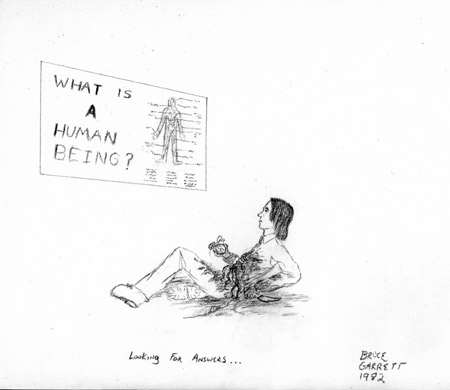
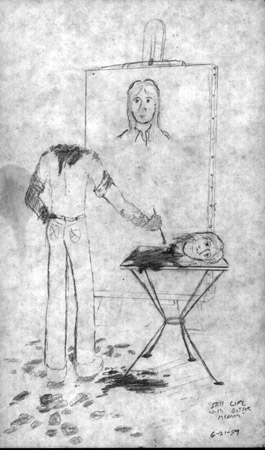
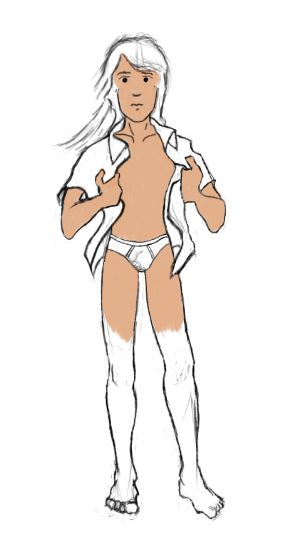
My sexual orientation, my geeky techno babble, my ability to just disappear into my head for hours at a time, my odd fascination with seemingly random objects in the world around me. All that Weird Stuff inside of me, is also part of all this…
Maybe this image says something to you. It did to me when I was standing in front of it with my camera. Now you have it too.
And…this…
I do this. And also…this…
“…takes excessive interest in personal art projects.” Whatever. She may just as well have written that I take excessive interest in electronics, in books, in the other boys.
It’s a struggle familiar to most gay people, even those who haven’t had to make room for sex and God, often uncomfortable bedfellows. Choosing to come out can still mean choosing away from family and friends who just can’t accept us as well as making institutions like marriage and parenthood exponentially more difficult to access. For Knapp, the process of bringing faith and sexuality into a coherent self required her to step away from her life and career in the U.S. The music that had spoken through her voice and hands became completely alienating. “I would think, I don’t even have a right to sing a song I wrote, because I am a hypocrite,” she says. Knapp spent her first three years as “a PlayStation guru,” and, when she tired of that, spent four years working at everything but music. She didn’t even pick up a guitar until her last year in Sydney. “I was building something new, starting something fresh,” she says. “I had to go someplace that would completely redefine my perspective of who I was in the universe.”
Coming out is, I have come to realize in my middle ages, not only an issue for gay people. A good slice of the human race have issues with being told they’re weird for various reasons. We’re encouraged to bury those parts of ourselves so that our neighbors in this life don’t have to deal with things that don’t make sense to them. And yet, all that weirdness inside of us is sometimes considered useful. Beautiful even…
Later that night Knapp plays a set to a full house at Manhattan’s City Winery.
I read this on Andrew Sullivan’s site just as I was composing this blog post last night. And serendipity it was…
Eric Barker recently referred me to this interesting study, which looked at how elementary school teachers perceived creativity in their students. While the teachers said they wanted creative kids in their classroom, they actually didn’t. In fact, when they were asked to rate their students on a variety of personality measures – the list included everything from “individualistic” to “risk-seeking” to “accepting of authority” – the traits mostly closely aligned with creative thinking were also closely associated with their “least favorite” students. As the researchers note, “Judgments for the favorite student were negatively correlated with creativity; judgments for the least favorite student were positively correlated with creativity.”
This shouldn’t be too surprising: Would you really want a little Picasso in your class? How about a baby Gertrude Stein? Or a teenage Eminem?
Perfect! The little dears wouldn’t draw inside the lines and that makes teacher frown. But sometimes we make people smile too…
She follows old friend Derek Webb, a straight and happily married Christian artist, who plays “What Matters More,” a track off his recent album that is explicitly critical of antigay Christians. Knapp is less blunt, playing a mix of her Christian favorites and new songs that hew to themes of love and loss. She does include “Inside,” the song that broadcasts the fears and frustrations that lick around the edges of what is otherwise an exciting and joyful return to what Knapp does best. But as she closes the set, graciously telling the applauding crowd that the night’s schedule doesn’t allow an encore, it’s clear that no matter what happens next, Jennifer Knapp will be playing music
You have to let people be weirded out. You have to let them put you into whatever little box they have handy, that lets them quickly dismiss you, categorize you, calculate, number, index and catalog you. Some people just have to have their boxes. Just so long as you don’t put yourself into one. All those things that make you different from the others. It doesn’t matter they don’t understand. Just so long as you do. Or even if you don’t, that you’re comfortable with it. Better you don’t make sense to people sometimes, then you don’t make sense to yourself. Creativity and oddness just go hand in hand and you don’t want to wake up one day and realize you’ve buried everything inside of you that could have been grown wings and soared, that could have been beautiful, and now you can’t find it anymore.
How About A Day Of Keeping Your Hands Off The Altar Boys?
As usual, the upcoming Day Of Silence isn’t getting a warm reception everywhere. Like the California Catholic Daily for instance…
Keep your children home Pro-family groups urge parents to keep kids out of school on ‘Day of Silence’ (Editor’s Note: Some schools observe the “Day of Silence” on dates earlier or later than April 16. Parents should check with a particular school to determine if and when the observance is held there.)
TINLEY PARK, Ill. /Christian Newswire/ — On Friday, April 16, thousands of public schools around the country will permit students and teachers to refuse to speak during class during a political event sponsored by the Gay, Lesbian and Straight Education Network (GLSEN) called the Day of Silence, which is intended to increase society’s affirmation of homosexuality and Gender Identity Disorder. A national coalition of pro-family organizations is asking parents to call their children out of school on the Day of Silence if their school permits students and/or teachers to remain silent during class.
Under the guise of anti-bullying, GLSEN’s goal is to have all children come to believe that moral disapproval of homosexual acts constitutes bullying and hatred and to make it socially unacceptable to express their beliefs that homosexual acts are immoral and dangerous.
GLSEN is using publicly funded schools to promote its agenda.
Worried about the children are you?
Bullying gay kids, whether it’s done by other kids or by adults, is a form of child sexual abuse, and I can understand completely why that isn’t regarded as such a big deal in Ratzinger’s house. Every day is a day of silence for children who’ve been sexually abused in Ratzinger’s house…
This blog is powered by WordPress and is hosted at Winters Web Works, who also did some custom design work (Thanks!). Some embedded content was created with the help of The Gimp. I proof with Google Chrome on either Windows, Linux or MacOS depending on which machine I happen to be running at the time.