


























The Human Heart Cannot Be Digitized
Let me show you a personal favorite of mine. It’s a landscape by the master Frederic Edwin Church, who painted many amazing landscapes back in the mid to late 1800s.
Some say Twilight In The Wilderness is his magnum opus. Others that it’s Cotopaxi, which he did at the outbreak of the American Civil War; one of his more overtly symbolic paintings. Still others would say it’s The Andes of Ecuador, or Niagara Falls.
Church was criticized once for the heavy handed symbolism in his landscapes, and by way of reply (so I’m told) he did Coast Scene, Mount Desert. It’s a painting that seems on its surface to be your usual rendering of a stormy day at the coast. You’ve probably seen dozens of similar ocean scenes in the decorative art section of the furniture stores. Something nice to put over the sofa. But look closer. Linger a while with it. Let it speak to you. How does it make you feel? What is it saying to you?
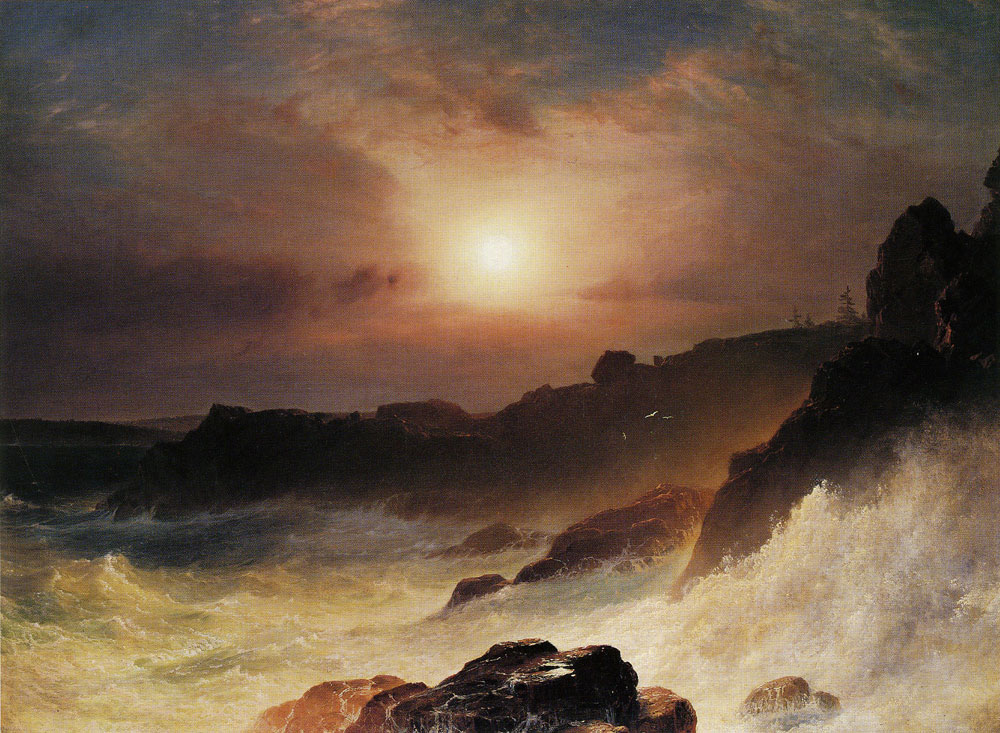
No snark please, I’m serious. This is serious. Today I sat in on what is supposed to be a series of staff knowledge sharing meetings to bring us all up to speed on how AI is going to change the way we work. AI I was told, would liberate us. But from what? The work? The work is everything to the artist. The creative urge lives for the work. I can see and appreciate the art of computer graphics. That is using the computer as another tool for the artist, like the camera became with the invention of photography. But the computer cannot become the artist. A machine cannot put meaning into a work, only a human can do that. All the machine can do is copy patterns and forms. The work of the artist isn’t rote repetition of patterns and forms.
I have been reading stories lately of screen actors being pressured into signing contracts with the studios to give them rights to their digital representation and voice. But the actor is not a body. The actor is an artist who brings characters to life, so to bring a story to life. Perhaps a computer animator can bring some semblance of life to a digital representation of an actor, but even then, unless the actor is working with the animator and giving voice to their digital representation, it is not them you’re seeing on the screen, just a copy of them, but without the life they would have given that performance. Without the meaning. That’s obviously not fair to the artist…but what does that do to the viewer?
I became a programmer from within a very dark part of my life. I was single, and devastated once again after what I thought was a second chance at love came apart. The art I started producing around then became very surreal and gruesome. Eventually I began to hate looking at it, and I stopped altogether. For nearly a decade I put my cameras and my drawing tools away, got myself stoned constantly, began drinking, smoking cigars, staying up all night listening to music that was as bleak as my inner self. The Lento-Allegro of Shostakovich symphony 1. The first movement of Shostakovich #8. The first two movements of Schmidt’s fourth. Vaughan-Williams symphony #6. Metal only imagines that it’s dark, but it’s a mere performative darkness. Schmidt wrote his forth after his daughter died unexpectedly while giving birth.
But the creative urge does not go away just because you desperately want it to. It will find another outlet. I began reaching out on computer bulletin board networks, lonely and aching for any sort of connection to other humans, and that led me deeper into the mechanisms of computer software, and the code that made it work. I began experimenting with writing software. And in doing that I discovered a beauty I’d never suspected. I saw beauty in the logic of code, that it could be written in simple, elegant, and beautiful logical forms. There was art in the code, and also a practical aspect: the more you wrote it simple, and elegant, and beautiful, the tighter you made it, the easier to maintain and debug.
I dove into that world and eventually it began making me a good living. I could be creative in a way that did not touch my heart, or any memories I did not want to go near. That is how the artist became a computer programmer. The best software engineers are artists.
Eventually I got back my need to create graphic art, though lately I’ve been struggling with it again.
The work is everything to the artist. The creative urge lives for the work. Now I am being told that I need to let the machines do the work, and that will somehow liberate me. But from what? My creative need? Then what will I become?
Our tools already take a lot of the work off of us. I code in a 4G language I don’t need to work out memory management. The IDEs give me tool tips, a degree of code completion, debugging while editing tools. GUI editors allow me to draw my user interface, add buttons, drop down menus, trap for mouse clicks, all without my needed to go down into the weeds. But the essential functionality, the code, is still mine. I can still work to the beauty of it.
But that kind of craftsmanship is an overhead. My entire working career in this trade I’ve been listening to corporate trying to figure out a way to get rid of us, while maintaining good enough quality. But this is the case in a lot of trades that depend on craftsmanship. Hollywood would love to have its actors and writers replaced with machines that generate good enough formula pablum for the masses.
I see the advantages of AI in science and medicine. For detecting patterns in the data, and suggesting new avenues of research. And to keep a watchful eye on the health of our spacecraft as they explore far from earth where no human can make repairs…HAL 9000’s regrettable glitch notwithstanding. But once the human is removed from the work, so is its meaning. And when we loose the meaning in our lives, we’re finished.
I need to make this specific. I read an article the other day about the decline in reading books for pleasure. It said that daily reading for pleasure in the US declined by over 40% in the last 20 years. And the thing of that is reading for pleasure grows us inside, building within us empathy, creativity and a lifelong curiosity for learning new things.
It’s not just reading. There are clear associations between creative engagement of all kinds, and emotional well-being.
Now take another look at who our president is.
I can’t ask a machine to create a work of art for me, but a machine can harvest my works, dryly analyze them, and spit out sterile copies that resemble my work but are utterly empty of meaning because a machine cannot give them meaning. A machine can find patterns in the data, and suggest new avenues of exploration. It can offer dollars and cents reasons to explore. It cannot tell us why it matters beyond a bottom line. It takes a human to do that.
Go outside on some clear starry night and look up at the sky. How does it make you feel? What is it saying to you?
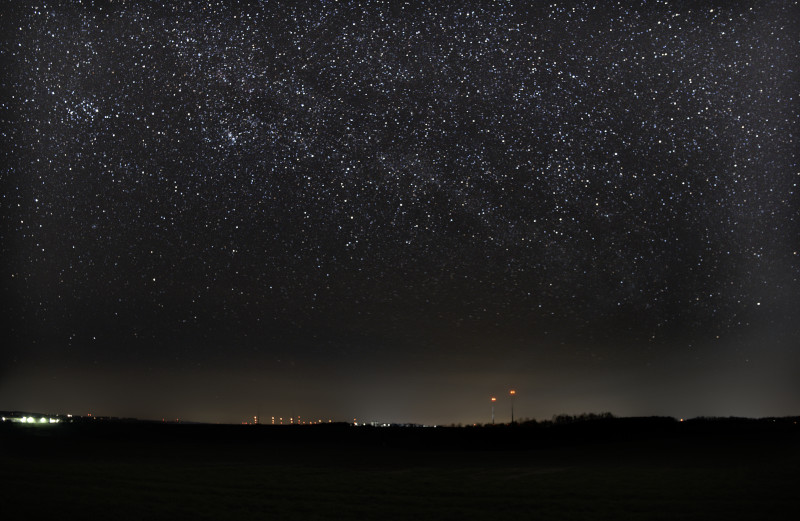
Clear Night Sky In Germany – Simple Wikipedia
“So Hillary climbed the mountain, not because it was there, but because he was.” -Eric Sevareid